AI for private dental and medical practices: keeping patient data on-site
At a glance
- Identifiable patient data is the most data-sensitivity-aware category most UK clinicians work with. The Caldicott Principles, the GDC standards for the dental team, the GMC's guidance, and CQC oversight all converge on a conservative posture toward third-party data processing.
- Cloud LLMs are workable in principle for clinical practice under enterprise DPAs and UK or EU regional endpoints, but the procurement and audit-trail overhead is high enough that many private practices end up looking at on-premises as the simpler answer.
- Five clinical workflows where on-premises AI fits today: consultation note drafting from dictation, referral letter generation, patient communication triage, treatment plan summarisation, and internal multidisciplinary team note discipline.
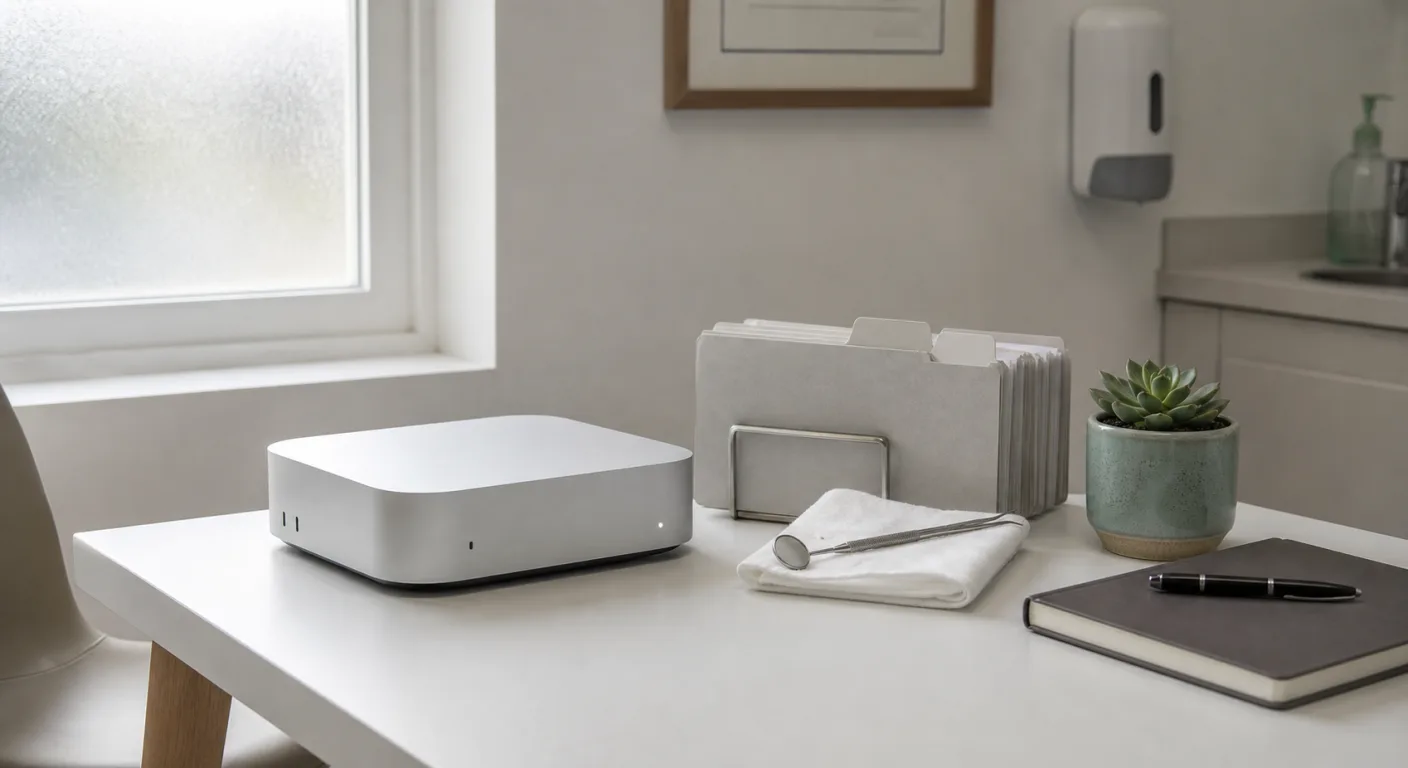
- Hardware footprint for a 4-chair dental practice or a single-handed GP: a single Mac mini M4 Pro running quietly in the back office. Nothing rack-mounted, nothing fan-noisy, nothing the practice's existing IT support cannot manage.
- Hybrid mode is appropriate for anonymised research and CPD work; not appropriate for identifiable patient data.
Why this is a separate question for private clinicians
UK private dental and medical practice operates under a stack of overlapping data and conduct frameworks that make AI procurement materially more involved than for an unregulated SME.
The frameworks that recurrently come up in scoping conversations:
- The Caldicott Principles. Originally articulated in the 1997 Caldicott Report, expanded over the years to the current eight principles. They govern the use of patient-identifiable information across health and adult social care. Principle 1 (justify the purpose), Principle 2 (use the minimum necessary), and Principle 7 (the duty to share information can be as important as the duty to protect confidentiality) are the ones that come up most often when AI is being introduced.
- UK GDPR and the Data Protection Act 2018. Health data is special category data under Article 9, which requires an Article 9 condition in addition to the Article 6 lawful basis. The DPA 2018 includes specific provisions for health and care.
- GDC Standards for the Dental Team. The General Dental Council's standards include obligations around confidentiality and professional conduct that apply to any technology choice the practice makes.
- GMC Good Medical Practice. The General Medical Council's standards apply to registered doctors. Confidentiality is one of the duties of a doctor.
- CQC oversight. The Care Quality Commission regulates most providers of medical and dental services in England. Where the provider is registered, the CQC's guidance on technology and digital tools applies.
- NHS England guidance. Even private practices that interact with NHS systems (referrals, prescriptions, regulated procedures) sit inside the NHS information governance perimeter for those interactions.
None of this rules out cloud AI in clinical practice. It does mean that the procurement and audit-trail overhead is high enough that on-premises is sometimes the simpler answer commercially as well as compliance-wise. The article below describes where local AI fits in private clinical practice, what it actually does, and the deployment shape that works.
The five clinical workflows where on-premises AI fits
1. Consultation note drafting from dictation
The clinician records a short verbal summary at the end of a consultation. The assistant transcribes the dictation, structures it as a clinical note in the practice's preferred format, and saves it to the practice management system through an MCP connector or API integration.
Why it matters: clinical note discipline is the largest source of post-consultation administrative load. A first draft that the clinician reviews and confirms typically saves 5 to 10 minutes per consultation, which across a busy clinic adds up to a meaningful recovery of clinician hours.
Why local: dictation includes patient identifiers, clinical findings, and (in dental cases) treatment planning detail. Sending this to a hosted cloud LLM is structurally a poor fit even where the DPA and the transfer mechanism are in order.
2. Referral letter generation
The clinician decides on a referral, dictates a short brief, and the assistant produces a referral letter in the practice's house format, populated with the relevant clinical context from the patient record. The clinician reviews and approves before the letter goes out.
Why it matters: referral letters are a recurring administrative task and a frequent bottleneck in patient flow. A draft that requires light editing rather than from-scratch composition saves 10 to 15 minutes per referral.
Why local: referral letters contain the full identifiable clinical picture by design. The on-premises route keeps the entire workflow inside the practice's network.
3. Patient communication triage
Patient queries arrive through email, the practice's online booking system, or written correspondence. The assistant classifies the query (booking, clinical, billing, complaint, urgent), drafts an appropriate response where the answer is straightforward, and routes the rest to the appropriate clinician or administrator.
Why it matters: patient communication volume is high and triage discipline is a known source of stress and inconsistency in single-handed and small practices. Reducing the time a clinician spends on inbox triage by 50% to 70% is a realistic outcome.
Why local: patient queries often include clinical detail disclosed before any structured intake has happened. Local processing keeps the data inside the practice from first contact.
4. Treatment plan summarisation
For dental practice in particular, treatment plans are often complex multi-stage documents that need to be summarised for the patient in plain language. The assistant produces a patient-facing summary of the plan, including the rationale, the alternatives, the costs, and the expected timeline.
Why it matters: clear treatment plan summarisation is a known driver of conversion from consultation to treatment, and a known source of differentiation between practices. A consistent, professional-quality summary across every patient interaction has a direct effect on practice revenue.
Why local: the underlying treatment plan includes the full clinical picture and the practice's commercial structure. Both are sensitive.
5. Internal multidisciplinary team (MDT) note discipline
For practices with several clinicians or with multidisciplinary involvement (general dentist plus hygienist plus specialist; GP plus practice nurse plus visiting specialist), the assistant produces consistent post-MDT meeting summaries with action tracking. The practice ends up with a more complete and consistent internal record than is typical with manual note-taking.
Why it matters: MDT discipline is a recurring source of CQC inspection findings and a recurring source of internal disagreement about whose responsibility it is to keep the notes. Automation that produces a draft for the senior clinician to review and confirm removes one of the recurring sources of friction.
Why local: MDT notes are clinical records by definition. They should not leave the practice.
Where Hybrid mode is appropriate
Hybrid mode is appropriate in two cases for private clinical practice and not appropriate in the others.
Appropriate:
- Anonymised CPD and case-discussion work. Reading published research, working through anonymised teaching cases, or producing CPD-relevant summaries from public clinical literature is a workload where the cloud frontier model's long-context advantage genuinely matters and where no identifiable patient data is involved.
- Practice-management research and policy work. Drafting a practice's data-protection policy, reviewing CQC inspection guidance, or producing internal training material from public-domain regulatory documents is appropriate cloud routing.
Not appropriate:
- Any workflow involving identifiable patient data. The local-only mode is the right answer here, full stop.
- Anonymised research where the anonymisation is not robust. Patient details that could be re-identified by a determined party (rare conditions, specific timing in a small practice's geography, distinctive treatment combinations) should not route to cloud even with names removed.
The Hybrid policy in a Private AI Concierge engagement for a private clinical practice documents these data classes explicitly. The default is local-only; Hybrid is opt-in only and never enabled retrospectively without a contract amendment.
Hardware footprint for a typical private clinical practice
The hardware footprint matters because clinicians typically work in space-constrained, noise-sensitive, ventilation-constrained settings. The Mac mini answers each of these:
- Physical size. 12.7cm square, 5cm tall. Sits on a shelf, a treatment-room cabinet, or an unused corner of a reception desk.
- Power. Under 100 watts under sustained inference load. No specialist electrical work needed.
- Noise. Effectively silent under normal load. Important for treatment rooms and small reception areas.
- Heat output. Low. No special ventilation requirements.
- Manageability. macOS is a familiar operating system. The practice's existing IT support, where one exists, can do basic operations on the device. The retainer covers the AI-specific work.
For a 4-chair dental practice or a single-handed GP, the Solo or Practice tier of Private AI Concierge is the typical fit. Hardware is invoiced at supplier cost; the configuration and installation fee is itemised separately.
Reference engagements in UK private clinical practice
The AI Consultancy has delivered AI strategy, sector research, and cloud architecture work across UK private dental practice, including high-end cosmetic and general-dentistry settings. We have also delivered category-defining clinical AI product strategy and multi-modal architecture for a London-based private dental practice operating off a decades-deep proprietary clinical archive, and cloud-native architecture for a multi-chain dental operation scaling from one to eleven practices.
Each of these engagements was scoped as a wider strategy and architecture project rather than as an on-premises AI deployment. Private AI Concierge is a newer service line addressing a different commercial need: not "what is the AI strategy for the practice", but "what is the appropriate deployment topology for the AI tooling the practice has decided to use, given the data sensitivity".
For more detail on the strategic and architectural side, see the AmniVogue dental, Wimpole dental, and multi-chain dental surgeries case studies.
What about NHS-facing work?
Most UK private clinicians do at least some NHS-facing work, whether through referrals, prescription writing, or specific regulated procedures. The data flows for those interactions sit inside the NHS information governance perimeter and are not affected by the on-premises deployment.
The on-premises AI assistant does not interact with NHS systems unless the practice explicitly wires it up. Where the practice does wire it up (for example, to ingest referral letters from an NHS source), the relevant NHS data security and protection toolkit (DSPT) considerations apply and we work through them as part of the workflow design sprint.
Where to start
If you are a private clinician evaluating AI tooling and the data-sovereignty question is in the way, the next step is a free 30-minute scoping call. We work through the workflow mix, the practice management system, the regulatory overlay, and the data classes against your specific practice, and recommend a route.
The relevant service page is Private AI Concierge. The companion articles on local AI vs cloud AI and UK GDPR for AI assistants cover the supporting questions in more depth. For the strategic-architectural side of AI in private dental practice specifically, the case studies linked above are the closest reference points.
Frequently asked questions
- Is on-premises AI required for private clinical practice in the UK?
- Not required. UK regulators (CQC, GDC, GMC) are technology-neutral, and cloud AI under appropriate DPAs and transfer mechanisms is workable in principle. The reason private practices end up looking at on-premises is that the procurement, audit-trail, and Caldicott overhead can make the cloud route commercially uncomfortable for smaller practices, even where the route is technically permissible.
- What does the Caldicott framework mean for AI tooling in a private practice?
- The Caldicott Principles govern the use of patient-identifiable information. Principle 1 (justify the purpose), Principle 2 (use the minimum necessary), and Principle 7 (the duty to share can be as important as the duty to protect) are the ones that come up most often when AI is being introduced. The principles do not prohibit AI use; they shape the analysis of which data classes the AI should touch and through what processor.
- Can a sole-practitioner GP run this without specialist IT support?
- Yes. The Mac mini is a familiar consumer-grade device. The retainer covers the AI-specific work (Hermes Agent patching, model upgrades, CVE response, skill curation). The day-to-day operational footprint is a quiet device on a shelf that the practice does not need to think about between monthly retainer touchpoints.
- What about CPD work and reading published clinical literature with the AI?
- This is the workflow where Hybrid mode genuinely helps. CPD work, public-domain clinical literature, and anonymised case discussion benefit from the cloud frontier model's long-context advantage and do not involve identifiable patient data. The hybrid policy documents this explicitly: anonymised public-record content can route to cloud, identifiable patient data cannot.
- Does this affect the practice's existing NHS-facing work?
- No. The on-premises AI assistant does not interact with NHS systems unless the practice explicitly wires it up. Where the practice does wire it up, NHS data security and protection toolkit (DSPT) considerations apply and are addressed in the workflow design sprint.
Get new briefings by email
The AI Consultancy newsletter delivers briefings and analysis for UK businesses. We use your address only to send it, and you can unsubscribe at any time.