Agentic AI for UK businesses in 2026: costs and use cases
What is agentic AI, and how is it different from a chatbot?
Agentic AI refers to AI systems that plan and execute multi-step tasks by reasoning, calling tools, and acting against external systems on a user's behalf, usually with some degree of autonomy between human check-ins. In 2026 this is the category UK businesses are asking about most often after two years of chat-based AI, because the commercial case has shifted from drafting content to completing work. Gartner’s 25 June 2025 release forecast that at least 15% of day-to-day work decisions would be autonomous through agentic AI by 2028, compared with 0% in 2024. This is a forecast, not measured adoption. For most UK businesses the practical question is not whether to adopt agentic AI but where the first narrow, well-scoped agent belongs.
It helps to separate three categories that often get mixed up. Assistive AI is a tool the user drives: a chatbot, a writing assistant, a meeting summariser. Traditional automation follows a fixed script: a Zapier zap, a cron job, a scheduled report. Agentic AI sits between the two. It is given a goal, chooses its own steps, uses tools (APIs, browsers, internal systems) to act, and reports back. That flexibility is also the source of its risk profile, and most of this article is about managing that risk.
Three production patterns for UK businesses in 2026
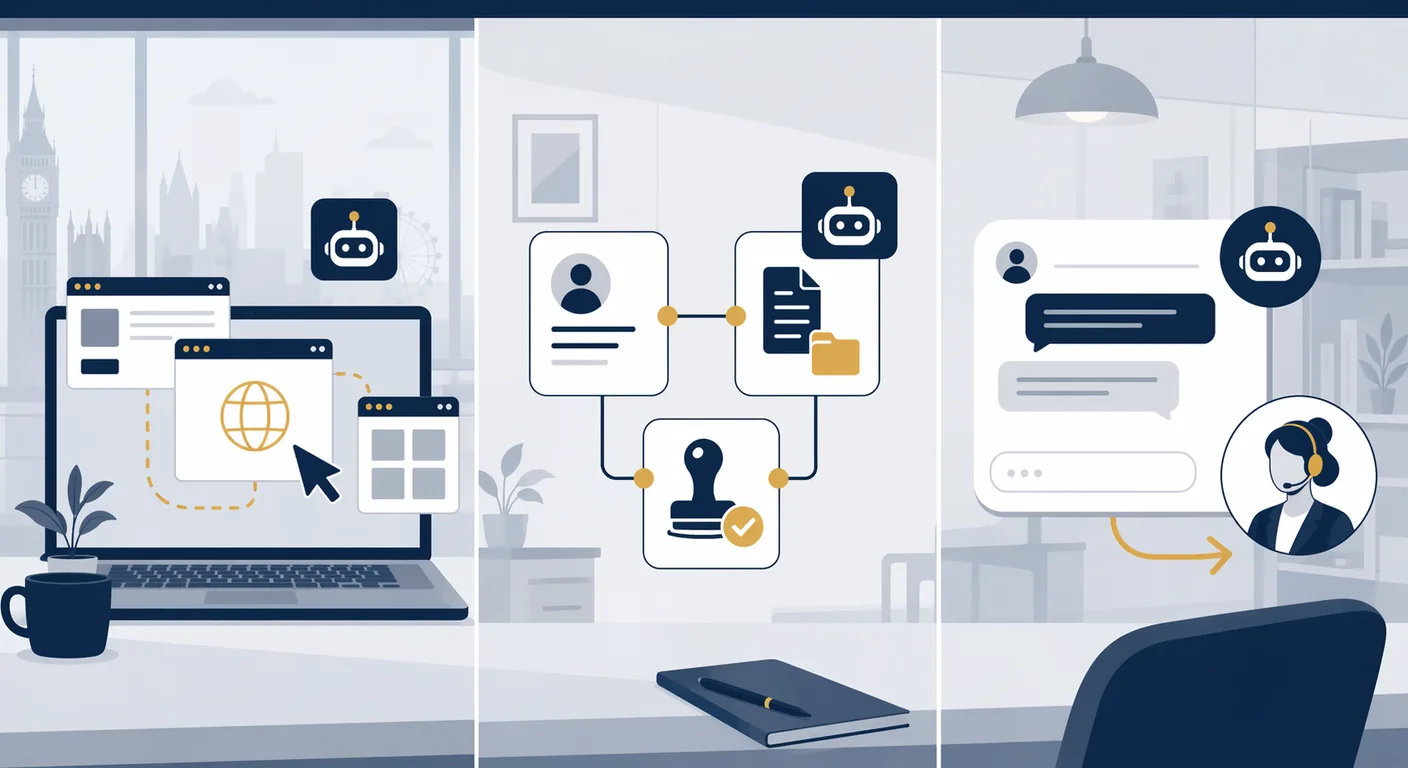
Most agentic builds that reach production in a UK SME or mid-market firm fall into one of three patterns. Understanding which pattern a problem fits saves a month of scoping work.
Pattern 1: the browser agent
A browser agent drives a web browser to perform tasks a human would perform in the same interface. Typical use cases: extracting data from supplier portals that do not expose an API, reconciling information across several systems none of which talk to each other, filling in repetitive public-sector forms, or running end-of-day checks across multiple SaaS dashboards. Browser agents are a sensible first build when the system of record cannot be integrated against directly but the task is repetitive and well-defined. The risk profile is moderate: the agent only acts where a human could, and most systems log browser sessions for audit.
Pattern 2: the internal workflow agent
An internal workflow agent is an API-connected agent that acts inside tools the business already owns. Typical stack: the agent reads context from a shared drive or CRM, drafts an output, applies business rules, and writes back to a system with a human approval step for anything commercially significant. This is the most common and lowest-risk pattern for UK SMEs. It is also the pattern that benefits most from retrieval-augmented generation for context, which we cover in our RAG for UK SMEs guide.
Pattern 3: the customer-facing agent
A customer-facing agent is an agent exposed to end users, typically via a website, WhatsApp, a phone line, or an email address. It is the highest-risk pattern because inputs are untrusted and mistakes are public. Customer-facing agents in 2026 should always sit behind three layers: a tight system prompt and tool whitelist, a handoff path to a human for anything outside the agent's remit, and a full audit log of every interaction. We do not recommend a fully autonomous customer-facing agent for any UK business handling regulated data or material commercial decisions.
What does an agent actually cost to build?
The honest answer is that it depends on the number of tools, the data readiness, and the level of human oversight required. The table below shows conservative GBP bands based on typical UK implementation rates in April 2026. They exclude ongoing inference costs (typically £200 to £3,000 per month depending on volume) and internal staff time.
| Build type | Scope | Typical GBP range | Realistic timeline |
|---|---|---|---|
| Narrow internal workflow agent | One workflow, two to four tools, light approvals | £15,000 to £40,000 | 6 to 10 weeks |
| Customer-facing support agent | RAG over knowledge base, ticket creation, human handoff | £35,000 to £90,000 | 8 to 14 weeks |
| Multi-system agent with approvals | Four plus tools, role-based access, audit log, test harness | £80,000 to £250,000 | 12 to 20 weeks |
| Browser agent over a single portal | One portal, structured output, error handling | £12,000 to £35,000 | 4 to 8 weeks |
Two common mistakes inflate these numbers. The first is picking a use case where the underlying data is not ready: cleaning the data costs more than the agent. The second is treating the agent as production-grade on day one, which pushes governance and testing work into scope before the pattern has been proven. A pilot at the lower end of the range, with a clear success criterion, is almost always the right first step.
The failure modes that matter
Three failure modes account for the overwhelming majority of agentic AI incidents in UK businesses.
Hallucination chaining
A single hallucinated fact inside a multi-step plan becomes the input for the next step, and the error compounds. An agent asked to update a supplier record might hallucinate the supplier's bank details, then act on that hallucination in downstream tools. The mitigation is to ground every factual claim in a retrieved source and to require explicit confirmation for any write that touches financial, contractual, or personal data.
Tool-permission leakage
Agents are often granted broad access for convenience during development and that access is never narrowed before production. A customer-facing agent with write access to the CRM can be manipulated via prompt injection to update records it should never touch. The National Cyber Security Centre's May 2026 guidance on agentic AI recommends least privilege and limiting agent scope. This is non-negotiable for any UK business in a regulated sector, and covered in more depth in our AI security risks guide.
Infinite loops and runaway cost
An agent that cannot make progress sometimes retries indefinitely, either because the stop condition is poorly defined or because each failed attempt generates a new prompt that looks like progress. Mitigation is a hard cap on steps per task, a cap on tool calls, a cost budget per run, and an alert if either is approached. These caps should be set in the first week of a build, not after a surprise bill.
Human-in-the-loop rules for UK businesses
The UK's emerging regulatory posture favours contextual, risk-based controls over prescriptive rules. The Information Commission guidance on automated decision-making under UK GDPR remains the primary reference point for any agent whose outputs materially affect an individual. For a UK business deploying agentic AI in 2026, five human-in-the-loop rules are a sensible default.
- Any write to a financial, HR, or legal system of record requires explicit human approval, not just after-the-fact review.
- Any outbound communication to a named individual (customer, supplier, candidate) passes through a human check on first use of a new template, then on a sample basis thereafter.
- Any decision with a direct commercial value above a defined threshold (we recommend £1,000 for most SMEs as a starting point) is queued for approval, not executed.
- Any task that touches personal data under UK GDPR is logged with the lawful basis, the retention period, and the data minimisation step applied.
- Any agent action that fails twice in a row is escalated to a human, not retried a third time.
These are floor rules, not ceiling rules. Regulated sectors (financial services under the FCA, healthcare, legal practice under the SRA) will have additional requirements documented in their own codes of conduct. For a deeper treatment of how UK regulation intersects with AI deployment, see our EU AI Act guide for UK SMEs.
Four 2026 use cases that are paying back
These four examples are the patterns we see most often in UK SME and mid-market engagements, not marketing claims. Each is a narrow, repeatable use case with a clear success measure.
- Professional services: matter intake and conflict checks. An internal workflow agent reads a prospective matter form, cross-references the firm's conflict database, drafts a conflict memo, and queues it for partner approval. Time from new enquiry to memo drops from two days to under four hours.
- Logistics: supplier portal reconciliation. A browser agent pulls daily status across a handful of customer and carrier portals, reconciles exceptions against the internal TMS, and drafts the morning operations email. The pattern has precedents in our logistics work; see our logistics and transport industry page for sector context.
- Healthcare and dental administration: appointment-rebook recovery. An internal workflow agent identifies cancellations with no rebook within 24 hours, drafts a personalised rebooking message, and queues it for front-desk approval. This is a low-risk use case because the agent never contacts patients directly.
- Financial services: KYB pack preparation. An internal workflow agent assembles a Know Your Business pack from Companies House, internal CRM, and publicly available sources, flags any discrepancies, and hands the file to a compliance analyst. The analyst remains the decision maker; the agent is a preparation layer.
How agentic AI differs from RPA
Robotic process automation (RPA) tools such as UiPath, Blue Prism, and Automation Anywhere have been used by UK enterprises for a decade. The surface similarity to agentic AI is real, and the two categories are converging. The practical differences still matter for scoping decisions.
| Dimension | Traditional RPA | Agentic AI |
|---|---|---|
| Decision logic | Deterministic rules, encoded upfront | Model-driven reasoning, adapts at runtime |
| Handling variation | Breaks when the form or screen changes | Usually copes with variation within scope |
| Observability | Step-by-step logs by default | Requires explicit logging of reasoning |
| Typical use case | High-volume, low-variance back-office work | Lower-volume, higher-variance knowledge work |
| Failure mode | Fails loudly and stops | Fails quietly and continues |
In practice, 2026 deployments often combine the two: RPA handles the deterministic parts of the workflow, and an agent handles the variable steps where judgement is required. Choosing between them is less about capability and more about who owns the control plane, the audit trail, and the change management process. Our implementation strategy guide covers this trade-off in more detail.
Regulatory considerations specific to the UK
Three UK-specific considerations apply to any agentic AI build in 2026. First, the government's February 2024 response to the AI regulation white paper confirmed a principles-based, regulator-led approach. That means regulators in each sector (ICO, FCA, Ofcom, MHRA) are the operative authorities. Second, UK GDPR Articles 22A to 22D apply to solely automated decisions with legal or similarly significant effects on an individual, including relevant employment and credit decisions. Third, for businesses that operate across the UK and EU, the EU AI Act's extraterritorial scope applies even if the business is UK-headquartered, and high-risk classifications carry distinct provider and deployer duties, with Article 26 governing deployers and the main high-risk dates deferred to December 2027 and August 2028.
Where to start: a pragmatic first-agent plan
A sensible first build is a narrow internal workflow agent with two to four tools, a human approval step on every consequential write, a hard cost cap per run, and a success measure expressed in saved hours or error-rate reduction, not in saved headcount. Six to ten weeks to a working pilot is a realistic target. The common failure pattern is to start with a customer-facing agent because it sounds impressive; the customer-facing pattern is where UK businesses should go third, not first.
For a structured readiness assessment before committing to a build, including data readiness, tool scoping, and governance review, see our AI readiness service. For delivery of the pilot itself, see our AI implementation service. For mid-market and enterprise deployments with compliance, audit, and role-based access requirements, see our Enterprise AI service. The AI Knowledge Hub's implementation section collects related guides on tech stack choice, data preparation, and change management.
Frequently asked questions
- What is the difference between agentic AI and a chatbot?
- A chatbot responds to user input turn by turn; the user drives the conversation. An agent is given a goal, chooses its own steps, calls tools (APIs, browsers, internal systems) to act, and reports back. Chatbots are assistive; agents are autonomous within their defined scope. In practice, many 2026 deployments combine the two: a chat interface on the surface, an agent underneath doing the work.
- How much does it cost to build an AI agent in 2026?
- For UK implementations in April 2026, a narrow internal workflow agent typically costs £15,000 to £40,000 for a working pilot in 6 to 10 weeks. A customer-facing support agent with retrieval and handoff sits in the £35,000 to £90,000 range. Multi-system agents with approvals and audit logs reach £80,000 to £250,000. These figures exclude monthly inference costs, which vary from £200 to £3,000 depending on volume, and internal staff time.
- What should a UK business build as its first agent?
- A narrow internal workflow agent with two to four tools and a human approval step on every consequential write. The use case should be a repetitive, well-defined task where the data is already clean and a clear success measure exists (saved hours, reduced error rate). Customer-facing agents are higher risk and should come third, not first. A six to ten week pilot with a defined go/no-go criterion is the right shape for a first build.
- What are the main failure modes of agentic AI?
- Three failures account for most incidents. Hallucination chaining, where a single wrong fact becomes the input for the next step and the error compounds. Tool-permission leakage, where broad development-time permissions are not narrowed before production, allowing prompt injection to reach sensitive writes. Infinite loops and runaway cost, where an agent retries indefinitely without a stop condition or budget cap. All three are mitigated by retrieval grounding, least-privilege tool scopes, and hard caps on steps and cost per run.
- How does agentic AI differ from RPA?
- RPA follows deterministic rules encoded upfront, so it handles high-volume low-variance work well but breaks on variation. Agentic AI uses model-driven reasoning and copes with variation within scope, but requires explicit logging of its decisions and a more careful audit layer. RPA fails loudly and stops; agents tend to fail quietly and keep going. Many 2026 deployments combine the two, with RPA handling the deterministic parts and an agent handling the variable steps.
- What UK regulations apply to agentic AI in 2026?
- The UK uses a principles-based, regulator-led approach rather than a single AI Act. The Information Commission governs automated decision-making under UK GDPR. The FCA's Consumer Duty applies to relevant retail customer outcomes at firms in scope. Sector regulators such as Ofcom, MHRA, and the SRA issue their own guidance. UK businesses operating across the EU also fall under the EU AI Act's extraterritorial scope, which adds documentation obligations for high-risk uses. The practical posture is to comply with the overlapping frameworks and track emerging UK-specific AI legislation.
Get new briefings by email
The AI Consultancy newsletter delivers briefings and analysis for UK businesses. We use your address only to send it, and you can unsubscribe at any time.