RAG for UK SMEs: a practical 2026 implementation guide
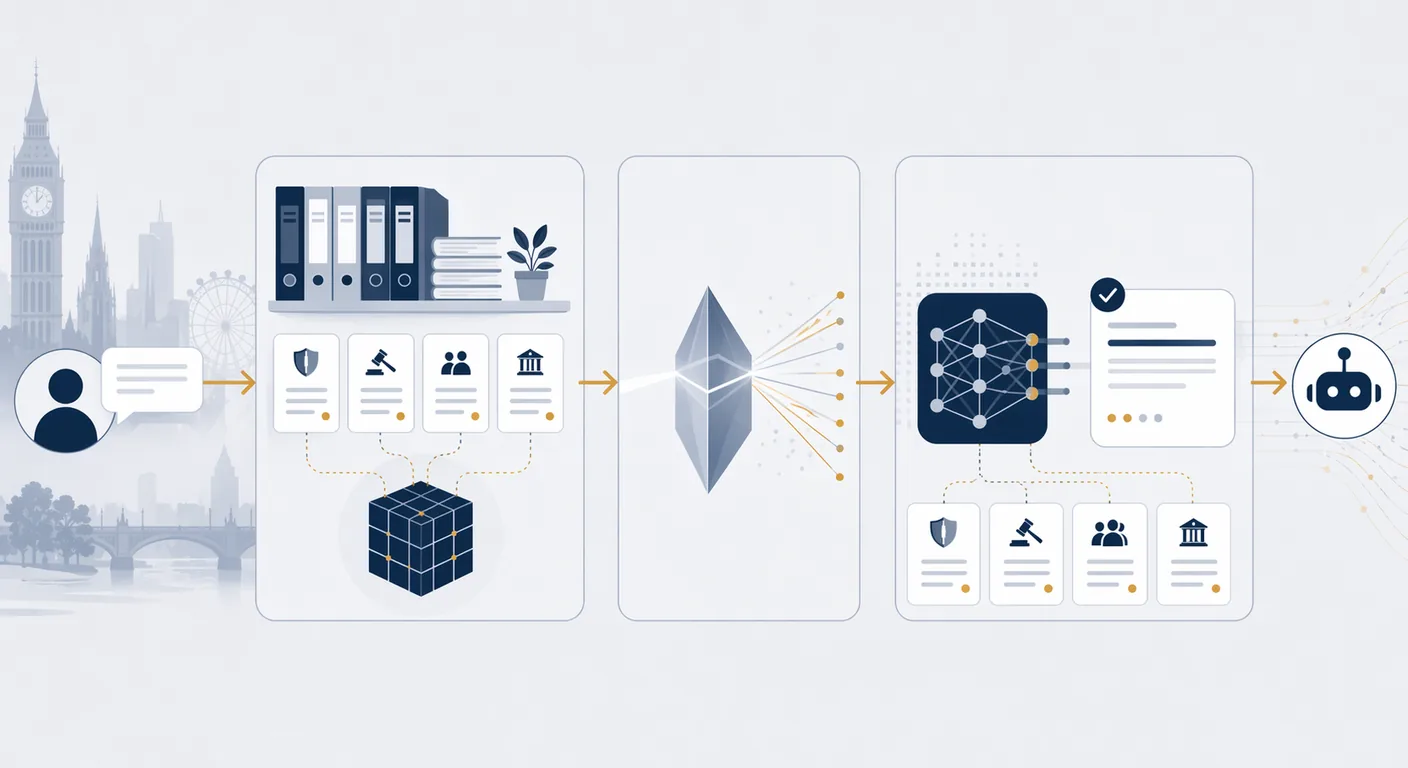
What is retrieval-augmented generation, in plain English?
Retrieval-augmented generation (RAG) is a pattern where a large language model is given access to a business's own documents at query time, rather than having those documents baked into the model. When a user asks a question, the system first searches an indexed copy of the business's content, pulls the most relevant passages, and hands them to the model as context. The model answers using those passages and cites them. RAG is the default way UK SMEs give AI tools access to their policies, product information, standard operating procedures, and case notes without pushing that content to a third party's training corpus.
A larger model used without retrieval cannot answer from documents it has never seen, so for questions about a business's own content a well-built RAG system on a mid-sized model is usually the better design. The price lists point the same way: in October 2026 Claude Sonnet 5.5 and GPT-6.1 Sol is listed at US$2 per million input tokens and US$10 per million output tokens, a fifth of the price of each vendor's top tier (Claude Fable 5.1 and GPT-6 Astra) at US$10 and US$50.
Why RAG and not fine-tuning or a long prompt?
Three techniques give a model access to your content: stuffing it into the prompt, fine-tuning the model on it, or retrieving it at query time with RAG. Each has a natural fit.
Prompt stuffing is right when the content is small, stable, and universally relevant (a style guide, a persona, a five-page policy). It breaks when the corpus grows past the context window or when different queries need different slices of the content. Fine-tuning is right when the task is about style, tone, or a narrow format the model does not produce natively, not about facts. Fine-tuning a model on facts typically underperforms RAG and is harder to update. RAG is right when the corpus is larger than a prompt can hold, changes over time, and is referenced selectively by different queries.
For most UK SMEs asking "how do we let our team ask our policies, product pages, and case notes?" the answer is RAG, not fine-tuning. Our AI tech stack guide for UK SMEs covers the broader tooling context.
UK GDPR and data residency considerations
Any RAG system built for a UK business handles personal data the moment a single document in the index names a person. That brings the entire pipeline (the vector store, the embedding model, the language model, and any logs) under UK GDPR. Five UK GDPR obligations apply directly to RAG: a lawful basis for processing, data minimisation at ingestion, transparency with data subjects, a documented retention policy, and appropriate controls on international transfers. The Information Commission has also published its response to a five-part consultation series on generative AI, covering the lawful basis for web scraping, purpose limitation, the accuracy of training data and model outputs, individual rights, and controllership across the supply chain.
The practical implication is residency. If the embedding model, vector store, or language model sits outside the UK or adequate jurisdictions, an international transfer mechanism (UK International Data Transfer Agreement or the Addendum to the EU SCCs) is required, with a documented assessment under UK GDPR Article 46(1A) that the data protection test is met (the ICO calls this a transfer risk assessment). Check storage and processing separately for each component, because a region name on a price list is not a processing commitment. As read on the vendors' own documentation on 10 October 2026: Azure AI Search stores and processes data within the Azure geography you select, and both UK South and UK West are available; Supabase offers a London region for the primary database; OpenAI's United Kingdom data residency region stores data at rest but does not process it in-region, while its Europe region does both; and Google's managed search service offers a European Union multi-region and no UK location. The free and consumer tiers usually offer none of these controls. A signed data processing agreement with a no-training clause is non-negotiable for any vendor in the pipeline.
For the wider posture around AI and data protection, see our AI acceptable use policy guide.
Choosing the embedding model
The embedding model is the component that converts each document chunk and each query into a vector so similarity search can work. The main managed choices in October 2026 are OpenAI text-embedding-3-large or text-embedding-3-small, Cohere's Embed 5 models (embed-v5.0-pro and embed-v5.0-fast), and Google's Gemini Embedding and text-embedding models; open-source alternatives such as BGE-M3 or E5-large-v2 suit self-hosted deployments.
Three criteria decide. First, residency: if the content is UK-only and you do not want it leaving UK or EU jurisdictions at any point, a self-hosted open model, or a managed model with a written processing commitment for that region, is mandatory. The commitment is set per model and changes with each release: record the provider, exact model, endpoint, processing commitment and date checked. Do not infer an embedding model's location from the region used by the vector database or language model. Google’s model lifecycle page, checked on 14 October 2026, schedules text-embedding-004, text-multilingual-embedding-002 and text-embedding-005 for retirement on 1 April 2027; include migration and re-embedding in the plan. Second, multilingual coverage: if the corpus includes documents in more than one language, a multilingual embedding model is worth the small quality trade-off. Third, cost at scale, which is smaller than most teams expect. A typical SME corpus of 50,000 to 500,000 chunks at 400 to 800 tokens each is 20 million to 400 million tokens. At OpenAI's list prices on 12 October 2026 (US$0.13 per million tokens for text-embedding-3-large and US$0.02 for text-embedding-3-small), the initial index costs between about US$0.40 and US$52, before tax or currency conversion, and embedding each query has a small separate charge; the dominant cost at scale is the language model, not the embeddings.
Vendor cost comparison (October 2026)
The table below compares four common paths to a working RAG system for a UK SME. Prices are the vendors' published list prices as read on 10 October 2026 and exclude the language model cost, which sits on top regardless of the retrieval backend. US dollar prices are converted at HMRC's October 2026 rate of US$1.3456 to £1; the Azure figures are Microsoft's own sterling retail rates for UK South. The residency column was checked against each vendor's documentation on the same day and describes the retrieval component only, not the embedding model or the language model. Refresh this table quarterly; vendor prices move, and so do their regional options.
| Option | Retrieval component | List price (10 October 2026) | UK / EU residency | Best for |
|---|---|---|---|---|
| Google Agent Search (formerly Vertex AI Search) | Managed search + vector | US$1.50 per 1,000 queries on Standard edition (about £1.11) or US$4.00 on Enterprise edition (about £2.97); index storage about US$5 per GiB a month (about £3.72) after 10 GiB free | EU multi-region for storage and processing; no UK location | Businesses already on Google Cloud |
| OpenAI Vector Store (file_search) | Managed vector store used by the file search tool in the Responses API (the Assistants API was removed on 26 August 2026) | US$0.10 per GB per day of storage after the first GB free (about £0.07); US$2.50 per 1,000 file search calls (about £1.86) | Europe region stores and processes; United Kingdom region stores only; eligibility agreed with OpenAI sales | Teams standardised on OpenAI |
| Azure AI Search | Managed search with vector support | Basic: £0.0762 an hour per search unit in UK South, about £56 a month; Standard S1: £0.2536 an hour, about £185 a month; cost scales with replicas and partitions | UK South and UK West; data stored and processed within the selected Azure geography | Microsoft shops with strict UK residency |
| pgvector on Supabase or Cloud SQL | Postgres with vector extension | Supabase Pro from US$25 a month (about £19), which covers one Micro compute instance and 8 GB of disk; Cloud SQL is billed by vCPU, memory and storage and varies by region | London region available on both | Teams with engineering capacity who want full data control |
The pattern we see most often at SME scale is pgvector on Supabase for the first pilot (cheap, stored in London if you choose that region, no lock-in) and a migration to Azure AI Search or Google Agent Search only if query volume and quality requirements justify the jump. Starting with a managed service is defensible too, but budget a month's migration work if the vendor's terms change.
A 6-week implementation plan
A realistic RAG pilot for a UK SME with a defined corpus (one or two document sources, a few hundred to a few thousand documents) runs in six weeks with a single developer and a part-time subject matter expert.
- Week 1: scope and source. Define two to three query types the pilot has to answer well. Identify the document sources, their current locations, and their owners. Draft the data classification rules: what is included, what is not, and why.
- Week 2: ingestion. Build the ingestion pipeline: fetch, clean, chunk (usually 400 to 800 tokens per chunk with 50 to 100 token overlap), embed, and store. Capture document metadata: source, owner, last-modified date, access level.
- Week 3: retrieval and prompting. Wire up the retrieval layer. Write the system prompt that instructs the model to answer only from retrieved passages and to cite sources. Add a "no answer" fallback so the model refuses when retrieval returns nothing relevant.
- Week 4: evaluation harness. Build a set of 50 to 100 held-out questions with correct answers and acceptable sources. Score the system's answers automatically where possible and manually where judgement is required. This is the step most teams skip and most teams regret skipping.
- Week 5: access and audit. Wire in authentication so each user only retrieves documents they are authorised to see. Enable query logging for audit and quality review. Add the UK GDPR-required transparency message where the interface is user-facing.
- Week 6: pilot and iterate. Deploy to a defined pilot group (typically 10 to 20 users), capture feedback, and iterate on chunking, prompting, and the "no answer" threshold. Do not scale beyond the pilot group until the evaluation harness shows stable quality for two consecutive weeks.
When NOT to use RAG
Three situations where RAG is the wrong default. First, if the use case is about style or format rather than facts, fine-tuning or a carefully written system prompt is usually better. Second, if the corpus is small and stable (under a few thousand tokens, changes rarely), simply pasting it into the prompt is cheaper, simpler, and more reliable than running a retrieval layer. Third, if the answer requires precise arithmetic, regulated calculations, or deterministic policy enforcement, a code-executing tool call (or a dedicated application with business logic) outperforms any retrieval-based approach and is auditable in a way LLM outputs are not.
A common anti-pattern is to build RAG over a set of documents that should really be a database. If your source of truth is structured data (product catalogue, prices, availability, transaction history), expose it via a tool the agent can call, not as text chunks to retrieve. Our guide to integrating AI with legacy systems covers the structured-data path in more detail.
How to evaluate a RAG system's quality
Quality in a RAG system is not a single number. Three measures together give a defensible picture, and a UK business should capture each before calling a pilot successful.
Retrieval quality. For each question in the evaluation set, did the retriever return at least one passage containing the correct answer? Measured as recall at k (typically k equals 5). A retriever at 85%+ recall at 5 is serviceable; under 70% and the language model cannot compensate regardless of how capable it is.
Answer faithfulness. Of the answers produced, how many are supported by the passages cited? Measured by sampling 50 to 100 answers and manually scoring each. A faithful answer may still be wrong if retrieval missed the right source, but an unfaithful answer (contradicts its own citations or fabricates a source) is the more serious failure and should drive system prompt or model changes.
Answer relevance. Does the answer address what the user actually asked? A faithful, correctly-retrieved answer can still miss the point if the model interpreted the question narrowly or broadly. This is where a business domain expert's judgement matters, and where an internal scoring rubric is more useful than any automated metric.
Teams that track all three over the six-week pilot usually identify the binding constraint early. Retrieval quality is most often improved by better chunking, re-ranking, or metadata filters. Answer faithfulness is improved by the system prompt and by switching to a more instruction-following model. Relevance is improved by conversational context handling and by giving the model room to ask clarifying questions when a query is ambiguous.
Security posture for a production RAG system
Four controls are non-negotiable for any UK business running RAG in production. Role-based access at retrieval time: each query should only return documents the user is permitted to see, enforced in the retrieval layer rather than the UI. Source tracking in every answer: the user sees which documents were consulted, which is both a UX improvement and a UK GDPR transparency control. Prompt injection defences: retrieved passages can contain adversarial instructions, so the system prompt must treat retrieved content as untrusted and ignore imperative instructions inside it. Query and output logging with defined retention: logs are part of the processing record and are subject to retention rules just like the source documents.
For sector-specific considerations, see our professional services industry page and our financial services industry page.
Where to start
Most UK SMEs should start with a narrow RAG pilot on a single, well-defined corpus (HR policies, product knowledge, a specific client engagement archive) before generalising. Six weeks to a working pilot is realistic; a further four weeks of iteration is typical before the system is production-ready. For structured readiness assessment before a build, see our AI readiness service. For delivery, see our AI implementation service. For broader guidance, the AI implementation section of the Knowledge Hub collects related articles on tooling, data preparation, and change management.
Frequently asked questions
- What is RAG in one sentence?
- RAG is a pattern where a large language model is given access to your own documents at query time: the system retrieves the most relevant passages, hands them to the model as context, and the model answers using those passages rather than its baked-in training data. It is the standard way UK SMEs let AI tools work with their internal content.
- How much does a RAG system cost to run?
- For a UK SME-scale corpus, the retrieval infrastructure is usually the smaller cost. At list prices read on 10 October 2026, pgvector on Supabase Pro starts at US$25 a month (about £19) and one Azure AI Search Basic unit in UK South costs about £56 a month. Google's managed search and OpenAI's vector store are priced by usage: US$1.50 per 1,000 queries on Google's Standard edition, and US$0.10 per GB per day of storage plus US$2.50 per 1,000 file search calls on OpenAI. The dominant ongoing cost is typically the language model itself, which depends on query volume and model choice.
- Does a RAG system keep our data in the UK?
- Only if you configure it that way, and only component by component. The vector store, the embedding model, and the language model can each sit in different regions, and a UK region for one says nothing about the others. The index is the straightforward part: Azure AI Search in UK South or UK West stores and processes data within that Azure geography, and a pgvector database on Supabase or Cloud SQL can sit in a London region. The models are harder: as of October 2026 few current language models carry a UK processing commitment, so the realistic options are one of the few UK-committed deployments, an EU-processed endpoint, or a self-hosted model. Google's managed search service offers an EU multi-region and no UK location. A data processing agreement with a no-training clause from every vendor in the pipeline is required, along with a documented international transfer mechanism if any component sits outside adequate jurisdictions.
- How long does it take to build a production RAG system?
- A working pilot on a defined corpus usually takes six weeks with one developer and a part-time subject matter expert. A further four weeks of evaluation and iteration is typical before the system is production-ready. Teams that skip the evaluation harness (week 4) usually spend that time later in rework when early users hit quality problems.
- What data works best in a RAG system?
- Text content that is reasonably well-structured and kept up to date: policies, product documentation, standard operating procedures, support articles, case study write-ups, and internal wikis. RAG struggles with heavy tabular data (use a database and tool calls instead), with scanned PDFs that have not been OCR'd, and with heterogeneous archives where the same question has contradictory answers across documents. Clean the source before you index it; quality at ingestion is the single biggest lever on answer quality.
- When is RAG the wrong choice?
- When the task is about style or format rather than facts (fine-tuning or prompting wins), when the corpus is small and stable enough to fit in a prompt (prompt stuffing wins), or when the answer needs precise arithmetic or deterministic policy enforcement (a dedicated application with business logic wins). RAG is also the wrong default when your source of truth is structured data; expose that data as a tool the AI can call rather than as text to retrieve.
Get new briefings by email
The AI Consultancy newsletter delivers briefings and analysis for UK businesses. We use your address only to send it, and you can unsubscribe at any time.