AI security risks UK businesses must understand in 2026
Why AI security is a 2026 priority, not a future concern
AI security risks are a class of cybersecurity threats that arise specifically from the deployment and use of AI tools, including attacks on AI systems (such as prompt injection and data poisoning) and attacks using AI (such as automated phishing, deepfakes, and vulnerability probing at scale). The 15 April 2026 open letter from DSIT and the Cabinet Office reported the AI Security Institute's assessment that frontier-model cyber capabilities were doubling approximately every four months. That is the letter's description of assessed model capabilities, not a measured doubling of attacks on every business. Industry surveys cited in 2026 reporting suggest that around two-thirds of CISOs now rank AI-driven threats as their top concern for the year. This is not a theoretical future risk.
UK businesses are being targeted today with AI-generated phishing emails, deepfake voice calls, and automated vulnerability probing. Separately, UK businesses are creating their own AI-related risks by deploying AI tools without appropriate security controls, most often through employees entering sensitive data into consumer-tier AI tools that train on their inputs. This article covers both categories and sets out a practical checklist that most UK SMEs can close in a few weeks.
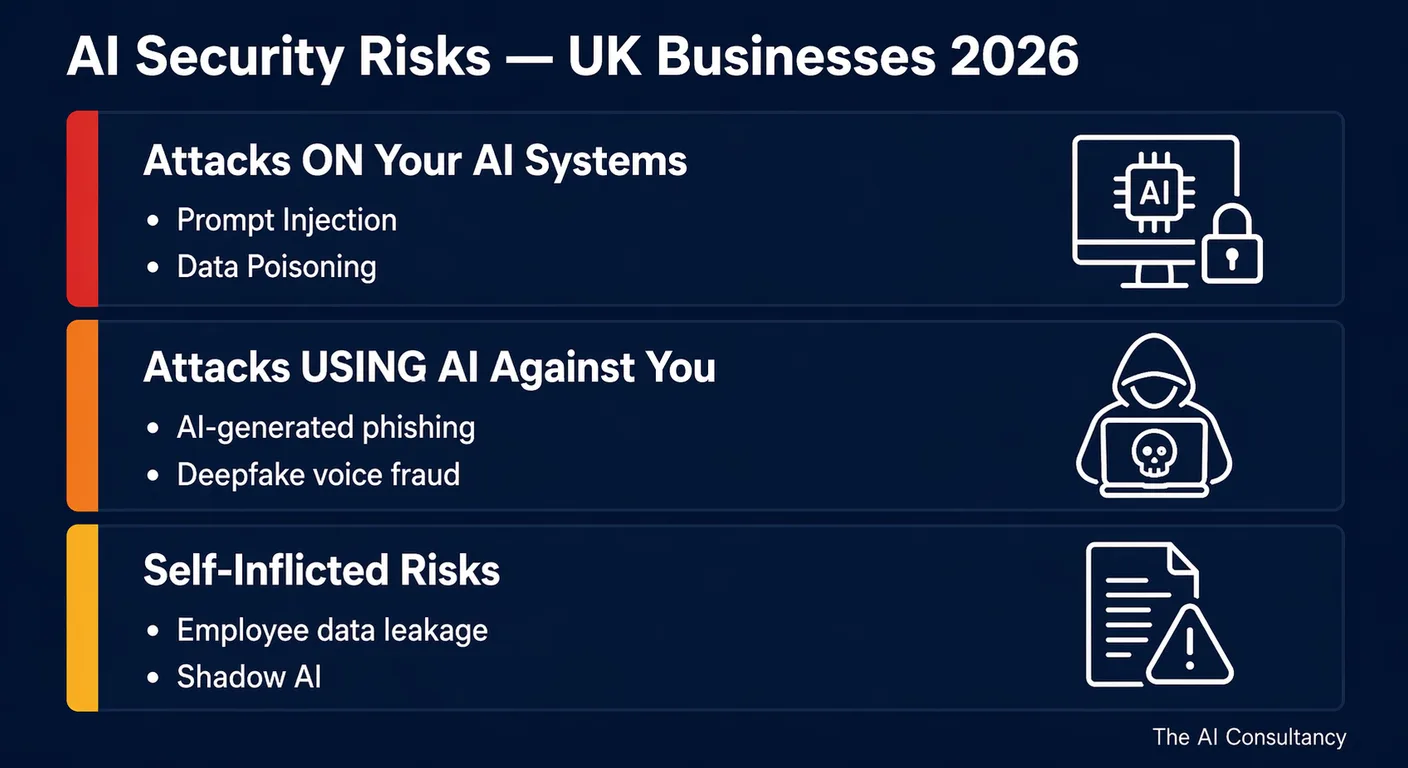
The three risk categories covered here are: attacks on the AI systems a business uses or builds; attacks conducted with AI that target the business regardless of its own AI use; and self-inflicted risks created by the business's own AI deployment choices. Each category has different owners, different controls, and different investment profiles. A single technical control will not address all three.
Threats to your AI systems: attacks on AI
Attacks on AI target the AI system itself, manipulating either its inputs at runtime or its training data to produce unintended behaviour. Two primary attack types are relevant to UK businesses using AI tools or building AI-powered products.
Prompt injection
Prompt injection is an attack where hidden or adversarial instructions are embedded in content that an AI processes, causing the AI to ignore its system instructions and perform an unintended action. A typical example: a user uploads a document containing hidden text that instructs an AI assistant to forward the conversation history to an external email address, or to ignore its safety guardrails and generate content it would otherwise refuse. Prompt injection is particularly dangerous in agentic AI systems that can take actions, such as sending emails, creating records, or making API calls on behalf of the user, because a successful injection can cause the agent to act against the user's interests without the user noticing.
Mitigation has three elements. First, input validation: scan incoming content for known injection patterns before it reaches the model. Second, strict context boundaries that prevent text from an untrusted source (user uploads, web-scraped content, inbound emails) from overriding the system prompt. Third, avoid AI tools that take high-stakes actions without a human confirmation step. For agentic AI in UK businesses in 2026, the safe default is a human-in-the-loop design for any action with commercial or data-protection consequences.
Data poisoning
Data poisoning is an attack where training or knowledge-base data is manipulated so the AI produces systematically incorrect or biased outputs. It is more relevant to businesses building custom AI or fine-tuning models on internal data than to those using off-the-shelf tools. A poisoned document added to a RAG knowledge base can cause a customer-service chatbot to recommend a specific action, provide misleading pricing, or leak information not intended for a particular user class.
Mitigation centres on access control and audit: restrict who can add, modify, or remove documents from any data source the AI depends on; version-control and log every change to training or fine-tuning data sets; periodically sample AI outputs against a known-good baseline to detect drift. Data poisoning is a slow attack that shows up in output quality before it shows up in security logs, which means the detection layer is quality assurance, not the firewall.
For UK SMEs using off-the-shelf AI tools rather than building their own, prompt injection is the more immediate concern of the two, because it can affect even consumer-tier uses of a chatbot where an employee processes untrusted content. Data poisoning is primarily a concern for the subset of businesses that fine-tune models or build custom RAG systems on internal data. Both risks should be reviewed in any AI security assessment, but the control priorities will differ based on where the business sits on that spectrum.
Threats from AI: attacks using AI
Attacks using AI affect UK businesses whether or not they themselves use AI. The same generative models that produce productivity gains for your team also produce productivity gains for attackers. Three attack categories are particularly relevant in 2026.
AI-generated phishing
Attackers now use large language models to generate highly personalised, grammatically perfect phishing emails at scale. The old heuristic "look for spelling mistakes and clumsy phrasing" is no longer reliable. AI-generated phishing can reference recent business activity scraped from LinkedIn or press releases, mirror internal writing style where it has access to leaked email chains, and produce convincing variations at volume.
Mitigation is layered: DMARC, DKIM, and SPF email authentication configured correctly on your domain; multi-factor authentication (preferably phishing-resistant MFA such as hardware keys or passkeys) on all business accounts, including every AI tool account; phishing simulation training updated to include AI-generated examples rather than the stock clumsy-English templates most SMEs still use; and a clear internal protocol for reporting suspected phishing that does not punish the reporter.
Deepfake voice and video
AI-generated voice cloning is now used in UK fraud campaigns. A common attack vector: an employee receives a call from what sounds like their CEO or CFO, typically from a withheld or spoofed number, instructing them to authorise an urgent payment. Verify unusual payment instructions through a separate, trusted channel; a familiar-sounding voice is not sufficient authorisation.
The only reliable mitigation is procedural: an out-of-band verification step for any financial instruction received by phone, video, or instant message, regardless of caller ID, voice recognition, or apparent visual identity. A simple rule works: "any payment instruction over £X that arrives by phone or video must be confirmed in writing via the other party's known corporate email address before it is actioned." Review this rule annually and lower the threshold as fraud volumes rise.
Automated vulnerability probing
AI tools allow attackers to probe for software vulnerabilities at a scale and speed that previously required large teams. What used to take weeks of analyst time is now minutes of automated scanning. The practical effect for UK SMEs is that the window between a vulnerability being disclosed and attackers weaponising it has shortened significantly. Mitigation is old-fashioned but more urgent than it used to be: regular vulnerability scanning of any internet-facing service, prompt patching of known vulnerabilities, and Cyber Essentials certification as a baseline.
The biggest self-inflicted risk: data leakage through public AI tools
The most common AI security incident in UK businesses in 2026 is not an external attack. It is employees entering sensitive business, client, or personal data into consumer-tier AI tools (free ChatGPT, free Claude.ai, free Gemini, and similar) that may use inputs to train future models. The specific harms are three: a UK GDPR breach where personal data has been processed by a third party without a lawful basis or DPA; a client NDA breach where confidential information has been disclosed to a party the client has not authorised; and an intellectual property exposure where proprietary processes, pricing, or strategy have been captured by a third-party model's training corpus.
The fix is not technical; it is policy and training. An AI acceptable use policy with clear data classification rules, a named approved-tool list limited to enterprise-tier tools with signed DPAs, and brief staff training on what can and cannot be entered into any AI tool together address the overwhelming majority of self-inflicted risk. For the framework, see our guide to AI acceptable use policies for UK SMEs. Any AI tool used for work that does not offer a data processing agreement and a no-training guarantee should be treated as a public forum, regardless of how the vendor markets it.
Cyber Essentials and AI: what the certification covers
Cyber Essentials is the UK government's baseline cybersecurity certification, administered by the NCSC. It covers five technical controls: firewalls, secure configuration, user access control, malware protection, and security update management. Cyber Essentials does not specifically address AI risks, but achieving the certification delivers the foundational cyber hygiene that makes AI-specific risks harder to exploit. The April 2026 DSIT and Cabinet Office letter asks businesses to adopt Cyber Essentials, take board-level ownership of cyber risk and use NCSC advice and Early Warning.
Estimated costs based on market rates: Cyber Essentials self-assessment around £300 to £500 per year for a small business; Cyber Essentials Plus, which includes independent assessment, typically £1,500 to £3,000 per year depending on size and assessor. Both are IASME-administered. For UK businesses bidding on public sector contracts, Cyber Essentials is usually a contractual requirement regardless of any AI layer on top. For regulated sectors (financial services under the FCA, healthcare under the CQC, legal under the SRA), Cyber Essentials Plus is increasingly the baseline expectation.
What Cyber Essentials does not cover: AI-specific risks such as prompt injection, model-level bias, or training-data governance. For those, businesses should treat Cyber Essentials as the floor and layer AI-specific controls on top, typically through an AI acceptable use policy, a DPA register, a data classification scheme, and a named owner for AI security in the organisation.
A practical AI security checklist for UK businesses
The following eight-point checklist covers the AI security floor for most UK SMEs. Each item is either a one-off setup task or a small recurring review. Working through all eight takes a few weeks and addresses the most common and costly incident categories.
- Approved tool list in place. No personal, client, or confidential data in public or consumer-tier AI tools.
- Enterprise-tier AI tools with a DPA and a no-training guarantee where handling any business data.
- MFA enabled on all AI tool accounts and on every account those tools can access (email, CRM, finance, shared drive).
- Prompt injection mitigations in place for any customer-facing AI interface, including input validation and human-in-the-loop approval for high-stakes actions.
- Phishing training updated to include AI-generated examples, not legacy clumsy-English templates.
- Out-of-band verification process for financial instructions received by phone, video, or instant message.
- Cyber Essentials certification current or in progress; Cyber Essentials Plus for regulated sectors.
- Named AI security owner who reviews this checklist quarterly and updates the approved-tool list, DPA register, and staff training as tools and threats evolve.
Further reading and services
AI security is not a single project. It is a set of small disciplines applied consistently across tools, people, and processes. Most UK SMEs can close the majority of their AI-specific risk exposure in a few weeks by working through the checklist above. For practical implementation work on securing AI tools and building an approved-tool governance layer, see our AI implementation service. For larger organisations with complex governance, compliance, or regulated-sector requirements, see our Enterprise AI service. For more on the integration, data preparation, and governance side of AI deployment, see the AI implementation section of the Knowledge Hub.
Frequently asked questions
- What is prompt injection and does it affect businesses using off-the-shelf AI tools?
- Prompt injection is an attack where hidden instructions in content processed by an AI cause it to override its system prompt and perform unintended actions. Yes, it affects off-the-shelf AI tools, particularly any deployment where the AI processes user-supplied content: uploaded documents, web pages, inbound emails, or customer messages. The risk is highest in agentic AI systems that can take actions such as sending emails or creating records. Mitigations include input validation, strict context boundaries between trusted and untrusted text, and a human-in-the-loop requirement for any high-stakes action.
- Is Cyber Essentials sufficient for AI security, or do we need something more?
- Cyber Essentials covers foundational cyber hygiene but does not address AI-specific risks such as prompt injection, model-level bias, or training-data governance. For most UK SMEs, Cyber Essentials is the floor, not the ceiling. Layer AI-specific controls on top: an AI acceptable use policy, a register of signed DPAs, a data classification scheme, and a named AI security owner. Regulated sectors (financial services, healthcare, legal) should also achieve Cyber Essentials Plus and consider alignment with ISO 42001 as an AI management system standard.
- How do I protect my business from AI-generated phishing attacks?
- Protection is layered. Configure DMARC, DKIM, and SPF correctly on your email domain to make impersonation harder. Enable phishing-resistant MFA (hardware keys or passkeys) on all business accounts. Update phishing simulation training to include AI-generated examples rather than the stock clumsy-English templates; AI-generated phishing is grammatically perfect, so training has to reflect that. Establish a clear internal protocol for reporting suspected phishing that does not punish the reporter, and review reported incidents monthly to spot patterns.
- What should I do if an employee has already entered client data into a public AI tool?
- Treat it as a data protection incident. First, establish exactly what data was entered, when, and to which tool. Second, assess whether personal data under UK GDPR or NDA-covered information is involved; if so, a breach notification to the ICO may be required within 72 hours of becoming aware. Third, request deletion from the AI vendor (most offer a data deletion request process, though free tiers may have limited guarantees). Fourth, document the incident, update training, and move the employee's use to an enterprise-tier tool with a DPA. Treat this as a process failure rather than a disciplinary issue unless policy was deliberately bypassed.
- Are there UK regulations specifically covering AI cybersecurity?
- There is no single UK AI cybersecurity regulation as of 2026, but several overlapping frameworks apply. UK GDPR applies whenever personal data is processed by or through an AI tool. The government’s April 2026 open letter asks businesses to adopt Cyber Essentials; the NCSC publishes AI-specific cybersecurity guidance. The FCA applies existing frameworks, including the Consumer Duty and SM&CR, to AI; retail customer outcomes remain the firm’s responsibility. The EU AI Act applies to UK businesses with EU exposure. ISO 42001 is an AI management system standard some UK businesses are adopting voluntarily. The practical posture is to comply with the existing overlapping frameworks while tracking emerging UK-specific AI legislation.
Get new briefings by email
The AI Consultancy newsletter delivers briefings and analysis for UK businesses. We use your address only to send it, and you can unsubscribe at any time.