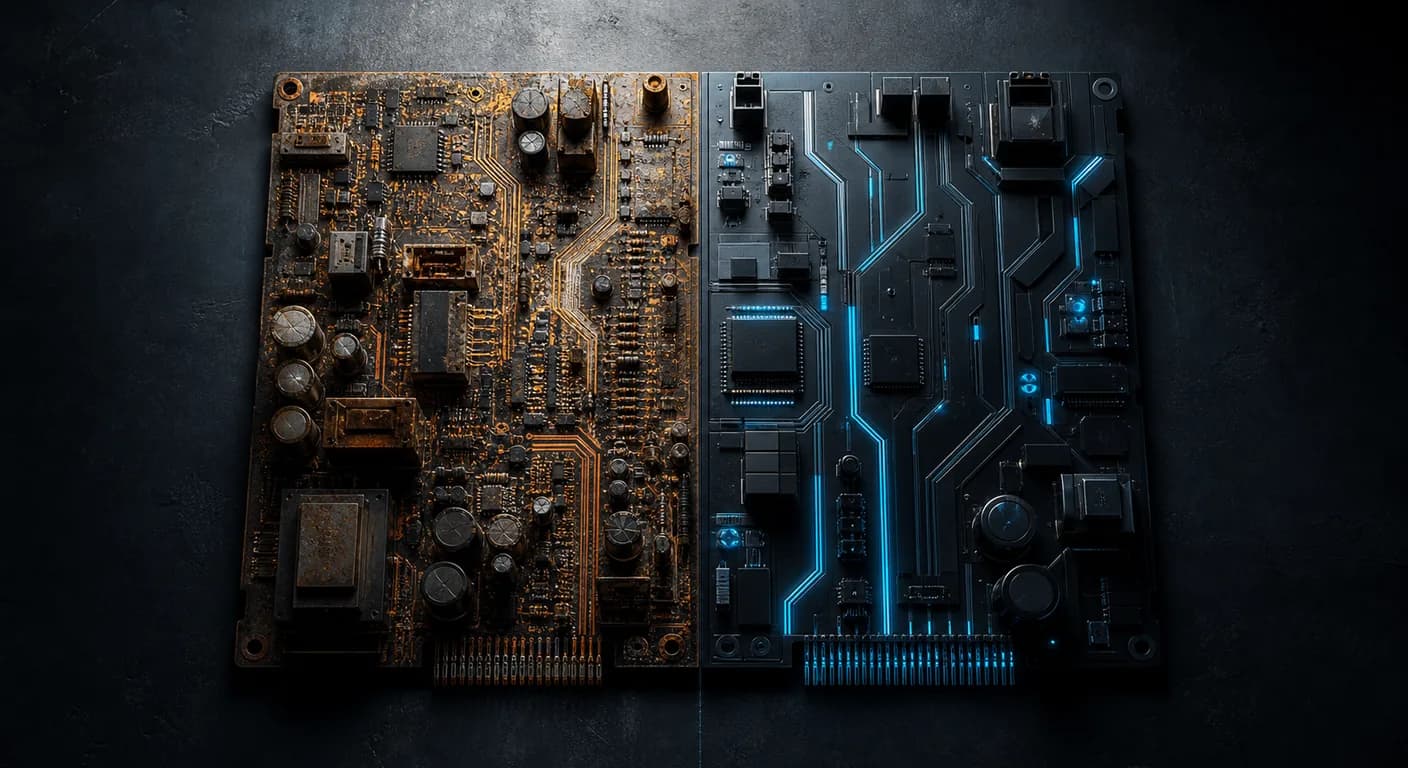
AI-Assisted Legacy Software Modernisation
Many UK businesses are running on software that was not designed for current operational requirements. An Access database from 2009, a bespoke system built by a developer who is no longer available, a CRM from a vendor that has discontinued the product. These systems work, but they constrain what the business can do and carry increasing operational risk. AI-assisted development has made replacement faster and significantly cheaper than a traditional software project, if it is managed correctly.
Senior engineering oversight throughout. Fixed-price discovery sprint. Production-ready delivery.
Book a Discovery CallWhat Has Changed About Legacy Replacement
Three years ago, replacing a bespoke legacy system meant a six-figure software development project, a six-to-twelve month delivery timeline, and a development agency who would remain your hostage for every future change. For most UK SMEs, the cost and risk of replacement exceeded the cost of continuing to operate the legacy system. The legacy stayed.
AI-assisted development has changed this calculation. A system that would have taken a traditional development team three months to build can now be produced in three to four weeks under senior engineering oversight, with AI coding tools handling implementation and a qualified engineer controlling architecture, security, and production readiness. The cost reduction is material: replacements that previously ran to GBP 80,000 to GBP 150,000 can now be delivered in the GBP 15,000 to GBP 50,000 range depending on complexity.
The caveat, and it is a significant one, is that AI-generated code requires engineering oversight to be production-safe. An AI coding tool used without architectural direction produces a prototype, not a production system. The Production Clinic exists for that exact gap. The legacy modernisation service applies the same oversight model from the first line of code rather than as a rescue engagement after the prototype breaks.
Systems This Service Applies To
The most common legacy systems we are asked to replace, in approximate frequency order:
- Microsoft Access databases. Access is still in widespread use across UK SMEs for operational data management , job tracking, stock control, customer records, financial reporting. The database works but cannot be accessed from outside the office network, cannot be used simultaneously by more than a handful of users, and cannot integrate with modern web-based tools. Replacement is a modern web application with a proper relational database, accessible from anywhere, with proper user permissions and audit trails.
- Bespoke legacy web applications. Systems built five to fifteen years ago by a developer or agency who is no longer engaged, in a framework that is no longer maintained, on a hosting environment that is approaching end-of-life. The source code exists but no current team member understands it fully. Changes require external contractors who charge day rates to familiarise themselves with an unfamiliar codebase. Replacement brings the system to a modern, maintainable stack with current documentation.
- Spreadsheet-based operational systems. Excel or Google Sheets workbooks that have grown into complex multi-tab operational systems shared across a team via email or shared drives. Data integrity is a recurring problem. Version control is informal. The system cannot scale. Replacement is a purpose-built web application that handles the same workflows correctly, with proper data validation and a proper database.
- Discontinued or end-of-life SaaS products. CRM, ERP, or vertical-software vendors who have discontinued a product, lost a key integration partner, or been acquired and absorbed. The existing data export is available; a replacement system needs to be built that replicates the essential workflows and imports the historical data cleanly.
- Manual paper-based processes ready for digitisation. Operational processes that are currently managed on paper, in physical files, or via informal systems, job sheets, compliance checklists, client intake forms, inspection reports , that have reached the scale where digitisation is overdue. AI-assisted development produces a first-generation digital system faster than any previous approach.
How the Engagement Works
Phase 1: Discovery Sprint (2 weeks, fixed price)
A structured analysis of the existing system and the replacement requirements. We review the current system, interview the users who depend on it, document the essential workflows, and produce a technical specification for the replacement. The specification covers the data model, the user roles and permissions, the integrations required, and the technology stack. At the end of the sprint, you have a clear picture of what the replacement will look like, how long it will take, and what it will cost. The discovery sprint fee is credited against the delivery project if you proceed.
Phase 2: Engineering Design (1 week)
A qualified engineer designs the application architecture before any AI tool writes a line of code. This is the step that distinguishes a production-quality AI-assisted build from a vibe-coded prototype: the data model is designed deliberately, the security model is specified upfront, the integration points are documented, and the deployment architecture is planned. The AI tools are used to accelerate implementation within this architecture, not to generate the architecture from prompts.
Phase 3: Delivery (3 to 10 weeks depending on complexity)
Implementation under continuous senior engineering oversight. AI coding tools handle the implementation work; the engineer reviews every significant component, controls all architectural decisions, and verifies security posture throughout. Daily progress updates. Staged delivery, working components are delivered and verified in sequence, not as a single release at the end of the project. User acceptance testing with the people who will actually use the system.
Phase 4: Production Deployment and Handover
The replacement system is deployed to production, the legacy data is migrated, and the team is trained on the new system. Handover documentation covers the system architecture, the deployment process, the routine maintenance tasks, and the process for requesting future changes. A 30-day post-deployment support window is included. Monthly Technical Support retainer available for ongoing maintenance.
Pricing
Modernisation projects are scoped individually after the Discovery Sprint. The ranges below are indicative, based on system complexity.
| System type | Indicative range | Typical timeline |
|---|---|---|
| Simple data management (Access replacement, basic workflow) | GBP 8,000 to GBP 20,000 | 6 to 10 weeks total |
| Medium-complexity web application (multi-user, integrations, reporting) | GBP 20,000 to GBP 50,000 | 10 to 16 weeks total |
| Complex system (multiple user roles, external integrations, data migration, compliance requirements) | GBP 50,000+ | Scoped per project |
Discovery Sprint: GBP 3,500 fixed (credited against delivery project). All prices exclusive of VAT.
Regulated Sectors
Legacy modernisation in regulated sectors requires additional consideration at the design stage. Financial services (FCA), healthcare (ICO, CQC, Caldicott, DSPT), legal (SRA), and professional services with sensitive client data all have specific data handling, audit trail, and access control requirements that must be built in from the design phase, they cannot be retrofitted to an application that was designed without them.
The AI Consultancy has delivered AI solutions across these sectors and applies the relevant regulatory overlay in the engineering design phase as standard. A UK GDPR Data Processing Agreement is included for all engagements handling personal data.
Why The AI Consultancy
The risk in AI-assisted legacy replacement is not the AI coding tool, it is the absence of qualified engineering oversight. An AI tool used autonomously produces what a vibe-coded prototype produces: something that works in a controlled environment and fails in production. The Production Clinic exists because this outcome is common enough to constitute a service category.
The legacy modernisation service applies the same oversight from the start. The AI accelerates delivery; the engineer ensures the output is production-safe, secure, maintainable, and correctly documented. The result is a new system delivered at a fraction of the cost of a traditional software project, without the production failures of an unmanaged AI build.
The AI Consultancy is an Anthropic Consulting Partner and holds professional indemnity insurance covering software development and advisory work. Jay Matharu leads delivery across our solutions practice.
Related services
- AI App Diagnostic Audit: the fixed-price engineering review for AI-built applications already in flight that need a production assessment.
- Agentic AI: design and build of internal workflow agents and customer-facing agents under the same engineering oversight model.
- AI Implementation: end-to-end AI delivery including Claude deployment, prompt engineering, and integration work.
Frequently asked questions
Can you migrate data from our existing system to the replacement?+
What happens if the existing system has no documentation or the original developer is unreachable?+
Can we keep the legacy system running alongside the new one during transition?+
How is this different from hiring a development agency?+
What if we need changes to the new system after delivery?+
Readiness Sprint from GBP 3,500 · Claude Enablement from GBP 4,500 · Discovery and Pilot from GBP 15,000 · Build and Embed from GBP 40,000 · Day rate GBP 950 to GBP 1,500. All prices exclude VAT.
Replace your legacy system without the legacy cost
Book a free 30-minute call to discuss whether your existing system is a fit for AI-assisted modernisation, the indicative scope, and the Discovery Sprint that confirms it.