Forward deployed engineering for UK SMEs: what it is, what it costs, and when you need it
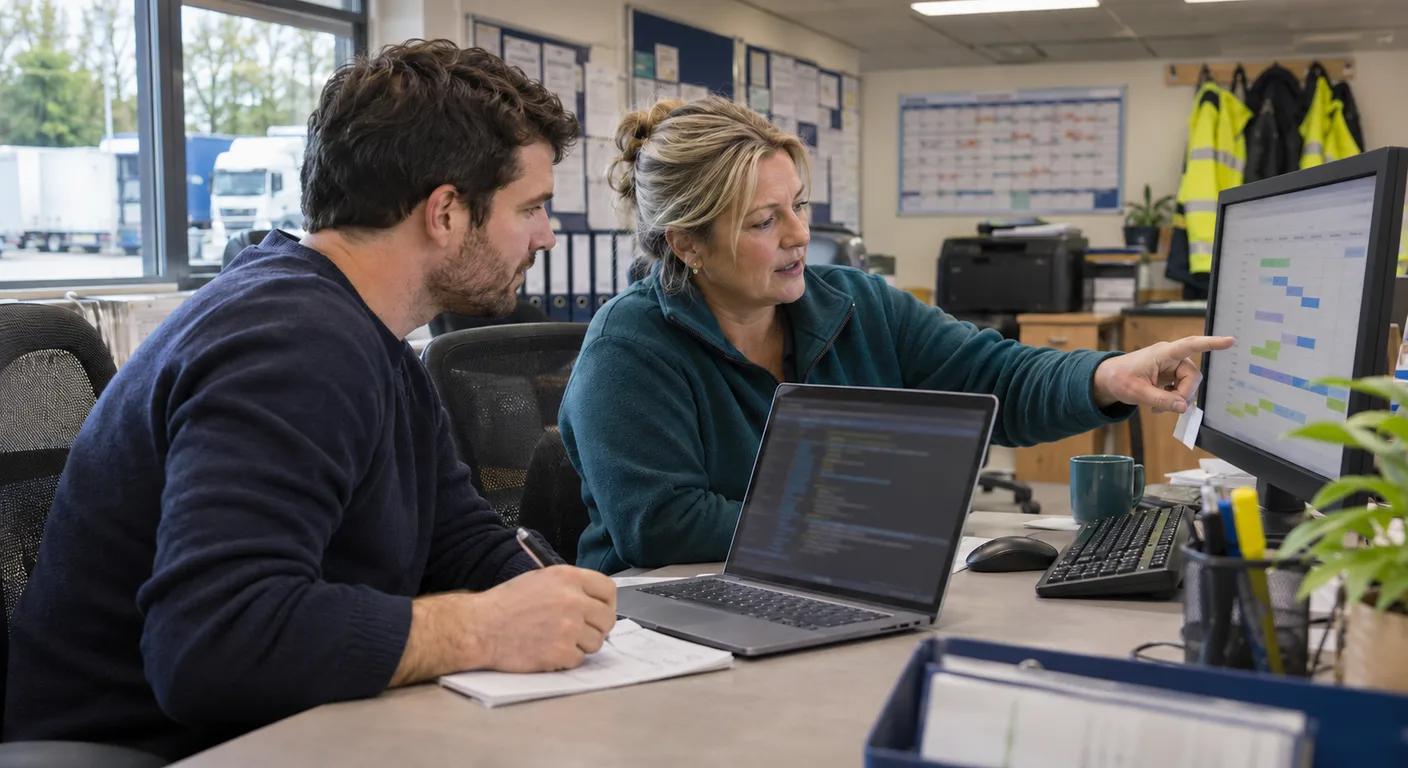
Forward deployed engineering is a delivery model in which an engineer works inside the customer's business, on its systems and data, to take a technology into production for that one customer. The engineer does not ship a product from outside and leave the customer to fit it; they sit with the operations team, learn the workflow, build against the real data, and stay until it works. Palantir popularised the role. More recently OpenAI and Anthropic have adopted it for frontier AI, built teams around it, and in May 2026 each announced a funded services venture to scale it. UK searches for the term averaged about 5,400 a month over the three months to September 2026, roughly six times the year before, and the title now appears on UK job boards well beyond the labs.
Most of what has been written about it is for engineers deciding whether to take the job, or for enterprises deciding whether to buy the programme. This article is for the UK business owner, operations director or technology lead at a firm of 20 to 500 people who has read the term, suspects it describes the help they need, and wants to know what it costs and whether there is a version of it at their scale. Time-sensitive facts carry the date they were checked, because this area is moving quickly.
What forward deployed engineering is, and where the model came from
A forward deployed engineer is a software engineer who builds for one customer, inside that customer's environment, rather than for many customers from outside it. Palantir, which coined the title, describes its forward deployed software engineers (internally, "Deltas") as engineers who embed directly with customers to configure the company's platforms to solve their problems, and draws the contrast plainly: a traditional software engineer creates a single capability for many customers, while a forward deployed engineer enables many capabilities for a single customer. The role grew out of Palantir's early government work, where the customer's data was fragmented, the customer could not describe its needs through normal product discovery, and the only way to deliver value was to put engineers on site.
Three things distinguish the model from ordinary consulting or systems integration. First, the engineer works in the customer's systems and on the customer's data, not on a mock-up. Second, the engineer is accountable for the outcome, not for a deliverable: the job is a working system in production, not a report or a demonstration. Third, in the versions the AI labs run, what the engineer learns flows back to the vendor's product, so the next customer needs less custom work. The third point matters more than it sounds, because it explains why the model has reappeared for AI.
Large language models are easy to demonstrate and hard to deploy. A model that performs well on a benchmark will fail inside a business if it cannot see the right data, if nobody has written the evaluation that defines "good enough" for that firm's task, or if the workflow around it was never redesigned. OpenAI's head of forward deployed engineering, Colin Jarvis, calls this the deployment gap: the distance between what models appear capable of and what people can reliably use to do their work. Closing it needs an engineer working inside the business.
How AI labs and deployment firms use FDE teams today
As at November 2026, the two frontier labs most active in the UK both run forward deployed teams and have each launched a venture built around the model. The details below are taken from their own published material, read on 8 November 2026.
OpenAI
OpenAI founded its forward deployed engineering team in early 2025. In an essay published on 22 October 2026, its head describes the team's operating rule as "start with the outcome, do what it takes to succeed, then follow with scale", and gives examples: around fifteen FDEs embedded with a semiconductor customer in mid-2025 on more than ten use cases, building evals with the customer's own engineers, plus custom harnesses per use case, until the systems reached production; and, once the workflows were rebuilt on common tooling, a second team's deployment taking one day where the first had taken two months. The team's stated aim is to make itself unnecessary for each class of problem by feeding what it learns back into the product and to research.
On 11 May 2026 OpenAI launched the OpenAI Deployment Company, a standalone business unit, majority-owned by OpenAI, with more than USD 4 billion of initial investment from nineteen partners led by TPG, with several global consultancies and systems integrators among the investors. At launch OpenAI agreed, subject to closing, to acquire an applied-AI consulting and engineering firm to bring about 150 forward deployed engineers and deployment specialists into the new company from day one. OpenAI describes a typical engagement as a diagnostic of where AI creates the most value, a small number of priority workflows chosen with the customer's leadership, and FDEs then working inside the organisation to design, build, test and deploy production systems connected to the customer's data, tools and controls.
Anthropic
On 4 May 2026 Anthropic, Blackstone, Hellman & Friedman and Goldman Sachs announced a standalone, AI-native enterprise services firm, with Anthropic engineering embedded in its team, to bring Claude into companies' core operations. The release names mid-market companies as a target: Goldman Sachs' Marc Nachmann described the aim as "democratizing access to forward-deployed engineers" so that mid-market firms could deploy Anthropic's technology. Anthropic's London careers page, read on 8 November 2026, advertises a Forward Deployed Engineer on its Applied AI team who embeds with its most strategic customers, builds production applications with Claude inside customer systems, delivers MCP servers, sub-agents and agent skills for production workflows, and travels to customer sites 25 to 50 per cent of the time. The published salary band is £225,000 to £255,000.
The wider market
The model has spread well beyond the labs. Indeed job-posting data reported by Business Insider on 16 May 2026 put the number of forward deployed engineer postings in April 2026 at roughly 729 per cent above April 2025, with Anthropic, OpenAI, Palantir and Stripe among the firms hiring. Lightcast, the labour-market data firm, counted about 200 US postings in 2024, about 1,200 in 2025 and more than 5,200 in the first seven months of 2026, and found that the skills employers ask for differ from a standard software engineering role: artificial intelligence, Python and workflow management lead, with communication alongside them. Palantir, the model's originator, reported US commercial revenue of USD 764 million in the second quarter of 2026, up 149 per cent on the year. A free directory, aideploymentfirms.com, now maps the category: as at November 2026 it lists close to 900 firms described as forward deployed engineers, AI implementation consultancies and agent builders, The AI Consultancy among them.
Two features of the lab programmes matter for a UK SME. They are aimed at large or strategic customers, and both are backed by investors with large portfolios of companies. A 60-person logistics firm is not going to get a team of OpenAI engineers. The question is what the equivalent looks like at that scale.
What it costs: hiring a forward deployed engineer versus engaging one
There are three ways to get forward deployed capability: hire an engineer onto the payroll, buy a lab's programme, or engage a specialist firm to deliver inside the business for a defined period. The costs differ by an order of magnitude and are set out below with UK sources and dates.
Hiring
Indeed UK's salary page for forward deployed engineers in England, updated 1 November 2026, shows an average of £107,126 a year from 124 reported salaries, a typical range of £61,957 to £185,224, and a London average of £114,122. That spread reflects how loosely the title is used: it covers everything from a solutions engineer at a software vendor to an AI engineer at a frontier lab. At the top of the market, Anthropic's London role lists £225,000 to £255,000. Employer's National Insurance, pension contributions, equipment and recruitment fees sit on top of any salary, and a single hire gives you one person's skills with no cover.
The harder cost is time. The skills that make the role work (production LLM experience, evaluation design, integration with business systems, and the ability to sit with an operations team and redesign a workflow) are scarce, which is why postings have multiplied faster than the people to fill them. For a firm that needs one production system this year rather than a pipeline of them, a hire is usually the slowest and most expensive route to the first result.
A lab programme
As at November 2026, neither OpenAI nor Anthropic publishes prices for forward deployed engagements, and the public descriptions make the target clear: strategic enterprise customers, complex problems, and portfolio companies of the backing investors. The nearest the labs come to the SME market, as at November 2026, is Anthropic's venture naming mid-market companies as a target. For most UK firms under 500 staff this route is not on the table, and it should not be assumed from a vendor's marketing that it is.
A fixed-scope engagement
The third route is to engage a firm that does the forward deployed work for a defined period and hands over. Our published prices, as at 8 November 2026, are the reference point we can vouch for: a Discovery and Pilot engagement of four to eight weeks from GBP 15,000, which takes a defined workflow to a working prototype on real or representative data, and a Build and Embed engagement of eight to sixteen weeks from GBP 40,000, which takes it to production with a 30-day post-launch support window. Both exclude VAT and are invoiced against milestones. Where a scope is too open-ended for a fixed quote, our day rate is GBP 950 to GBP 1,500 depending on seniority. For comparison, a Build and Embed engagement at its starting price costs less than five months of the Indeed average salary before on-costs, and ends with a documented system your own staff run rather than a vacancy to refill.
The trade-off runs both ways. A hire gives you continuous capacity and institutional memory. An engagement gives you a result sooner and cheaper, provided it ends in a real handover; an engagement that creates dependency on the supplier is a worse deal than a hire.
When a UK SME or mid-market firm needs the model
A business needs forward deployed delivery when the problem cannot be solved by configuring a product or by training staff to use an assistant. In our experience the signals are these:
- The workflow is specific to the business. The video survey platform we built for a removals group, a dental group's patient communication flow, or, say, a broker's case triage. No vendor's product does it, and the value is in the specificity.
- The data lives in three or more systems. A CRM, a finance system, a document store and a scheduling tool, with the real work happening in the gaps between them. The integration is the project; the model is a component.
- A pilot worked on test data and stalled on real data. The demonstration proved the idea; nobody owned the evaluation, the permissions and the error handling that production needs. This is the pattern we see most often.
- The data is regulated or sensitive. Client files, patient records, payroll. The work has to be done inside the firm's own environment with its own access controls, which rules out a remote build on a copy.
- There is no in-house engineer with production LLM experience. A capable IT team is not the same thing. Evaluation design, prompt and tool engineering, and cost control on agentic runs are new skills.
Equally, a business does not need the model when the job is adoption: getting staff to use Claude, ChatGPT or Microsoft Copilot well in their existing work. That is enablement, it is cheaper, and it is a different service. If none of the first three signals (a business-specific workflow, data in several systems, a stalled pilot) applies, start with a readiness assessment or an adoption engagement rather than an engineering one. Our guide to building versus buying AI covers the decision in more detail.
How The AI Consultancy's Build and Embed compares
We are not a forward deployed engineering firm, and we do not place engineers in client teams full-time. What we offer is the SME-sized version of the model: a fixed-scope engagement in which our engineers work inside your systems and alongside your staff for a defined period, build against your real data, deploy to production with the controls that implies, and hand over. The table sets out how the three routes differ.
| Feature | Lab FDE programme | In-house hire | Build and Embed |
|---|---|---|---|
| Who it is for | Large or strategic customers; investor portfolio companies | Firms with a pipeline of AI work | UK SMEs and mid-market firms with a defined workflow |
| Where the work happens | Inside the customer, often on site | Inside the business | Inside your systems, on site and remote, with your staff |
| Duration | Open-ended engagement | Permanent | 8 to 16 weeks, then a 30-day support window |
| Price | Not published | £107,126 average salary in England plus on-costs (Indeed, 1 Nov 2026) | From GBP 40,000 ex VAT, fixed-fee in most cases, against milestones |
| Model choice | The lab's own models | Your choice | Claude, OpenAI's GPT models, Gemini or open-weight, chosen per use case; no vendor income |
| What you keep | Depends on the contract | Everything, while the person stays | Code, prompts, evaluation harness, runbook and trained administrators |
In practice a Build and Embed engagement looks like this. It opens with discovery inside the business: we sit with the people who do the work, map the systems, agree the acceptance tests and classify the data. The build runs in weekly increments against those tests, with your operations staff reviewing real outputs rather than slides. Deployment is staged, with monitoring, alerting and a cost cap on agentic runs from the first production user. The final weeks are handover: an admin runbook, an acceptable use policy, role-specific training, and a 30-day window in which we fix what real usage finds. Our AI implementation consultants page sets out the deliverables, timelines and pricing; where the system is an autonomous agent with tool use, our agentic AI service covers the additional controls.
The "embed" in the name is deliberate and limited. During the engagement our engineers are embedded in your workflow, and your staff are embedded in the build. After it, the system is yours. That is the point at which our model and the lab model part company: a lab's FDE team builds on that lab's models, which is its purpose; ours builds on whichever model fits the use case and ends in a working system and a team that can run it.
Questions to ask any firm offering forward deployed engineers
The title is new enough that it is being applied to very different offers. Six questions help tell them apart.
- Where will the engineer actually work? Inside your systems with your staff, or remotely on a copy of your data? The model's value comes from the first.
- What is the engineer accountable for? A production system meeting written acceptance tests, or a deliverable? Ask to see the acceptance criteria before you sign.
- Is the price fixed, and what ends the engagement? Forward deployed work is open-ended at the labs; for an SME it should have a defined end and a handover.
- Which models will they use, and are they paid to prefer one? A lab's FDEs build on that lab's models. A consultancy should say whether it receives referral, reseller or deployment income from any vendor. We do not, and we say so on our independence page.
- Who will do the work, by name, and what have they shipped? Credentials are held by people, not firms. Ask for the named engineer and a production system they built.
- What do you keep? Code, prompts, the evaluation harness, the runbook, and accounts in your company's name. If the answer is vague, the engagement will create dependency.
Our buyer's guide to choosing an AI consultancy in the UK sets out seven broader questions and what good and weak answers sound like.
Where to start
If you have a workflow that fits the signals above, the shortest route is a free 20-minute call with the workflow, the systems it touches and what any pilot has proved. If you are not sure whether the problem is engineering or adoption, a readiness assessment answers that question for a fixed fee before any larger commitment, and our guide to what AI implementation costs in the UK covers the budget ranges and the hidden costs to plan for.
Sources
- Palantir, "A Day in the Life of a Palantir Forward Deployed Software Engineer", Palantir blog.
- OpenAI, "What FDE means at OpenAI", Colin Jarvis, 22 October 2026.
- OpenAI, "OpenAI launches the OpenAI Deployment Company to help businesses build around intelligence", 11 May 2026.
- Blackstone, "Anthropic Partners with Blackstone, Hellman & Friedman, and Goldman Sachs to Launch Enterprise AI Services Firm", press release, 4 May 2026; Anthropic, "Building a new enterprise AI services company".
- Anthropic careers, "Forward Deployed Engineer", London, UK, job listing read 8 November 2026.
- Business Insider, "Job postings for this tech role have grown more than 700% in the last year", 16 May 2026, citing Indeed data.
- Lightcast, "Q: What is a Forward Deployed Engineer? A: The fastest growing AI job", Elena Magrini, 15 September 2026.
- Indeed UK, "Forward deployed engineer salary in England", updated 1 November 2026.
- Palantir Technologies, second quarter 2026 results, 3 August 2026.
- DataForSEO search volumes via OpenSEO, UK, to September 2026; aideploymentfirms.com, read November 2026.
- The AI Consultancy, pricing and AI implementation pages, as published on 8 November 2026.
This article is general information for UK businesses, not employment, legal or procurement advice. Salary bands, job listings and the labs' programmes change quickly; the figures above were read on the dates given and should be checked before relying on them.
Frequently asked questions
- What is a forward deployed engineer?
- A forward deployed engineer (FDE) is a software engineer who works inside a customer's organisation to build, integrate and deploy a technology for that customer, rather than building a product used by many customers from a vendor's own office. The title comes from Palantir, which popularised the role; OpenAI and Anthropic now use it for engineers who embed with enterprise customers to put their models into production.
- How much does a forward deployed engineer earn in the UK?
- It depends heavily on the employer. Indeed UK's salary page for England shows an average of £107,126 a year from 124 reported salaries, with a typical range of £61,957 to £185,224 and a London average of £114,122, updated 1 November 2026. At the top of the market, Anthropic's London Forward Deployed Engineer role lists £225,000 to £255,000 a year (careers page read 8 November 2026). Employer's National Insurance, pension and equipment sit on top of any salary.
- Can a UK SME get a forward deployed engineer from OpenAI or Anthropic?
- Not in the way a large enterprise can, as at November 2026. Anthropic's FDE role describes embedding with its most strategic customers, and the OpenAI Deployment Company describes working with organisations on complex problems, with partners that between them sponsor more than 2,000 businesses. Anthropic's enterprise AI services firm names mid-market companies as a target, which is the nearest any lab programme comes to the SME market. For most UK SMEs the practical route is a specialist consultancy engagement delivered inside the business, or a hire.
- Is The AI Consultancy a forward deployed engineering firm?
- No. We do not place engineers in client teams full-time. Our Build and Embed engagement is the SME-sized version of the model: a fixed-scope build of 8 to 16 weeks, fixed-fee in most cases, from GBP 40,000 ex VAT, delivered on-site and remotely inside your systems and alongside your staff, ending in a documented handover and a 30-day support window. Discovery and Pilot, from GBP 15,000, is the shorter first step.
- When does a business need the forward deployed model rather than a product or a rollout?
- When the workflow is specific to the business and touches several systems, when a pilot has worked on test data but stalled on real data, when the data is regulated or sensitive, and when there is no in-house engineer with production LLM experience. If staff simply need to use Claude, ChatGPT or Copilot well, that is an adoption or enablement job, not an engineering one.
Get new briefings by email
The AI Consultancy newsletter delivers briefings and analysis for UK businesses. We use your address only to send it, and you can unsubscribe at any time.