Building Robust AI Governance Frameworks: A CRO’s Guide to Risk Management in the Age of Artificial Intelligence
Executive Summary
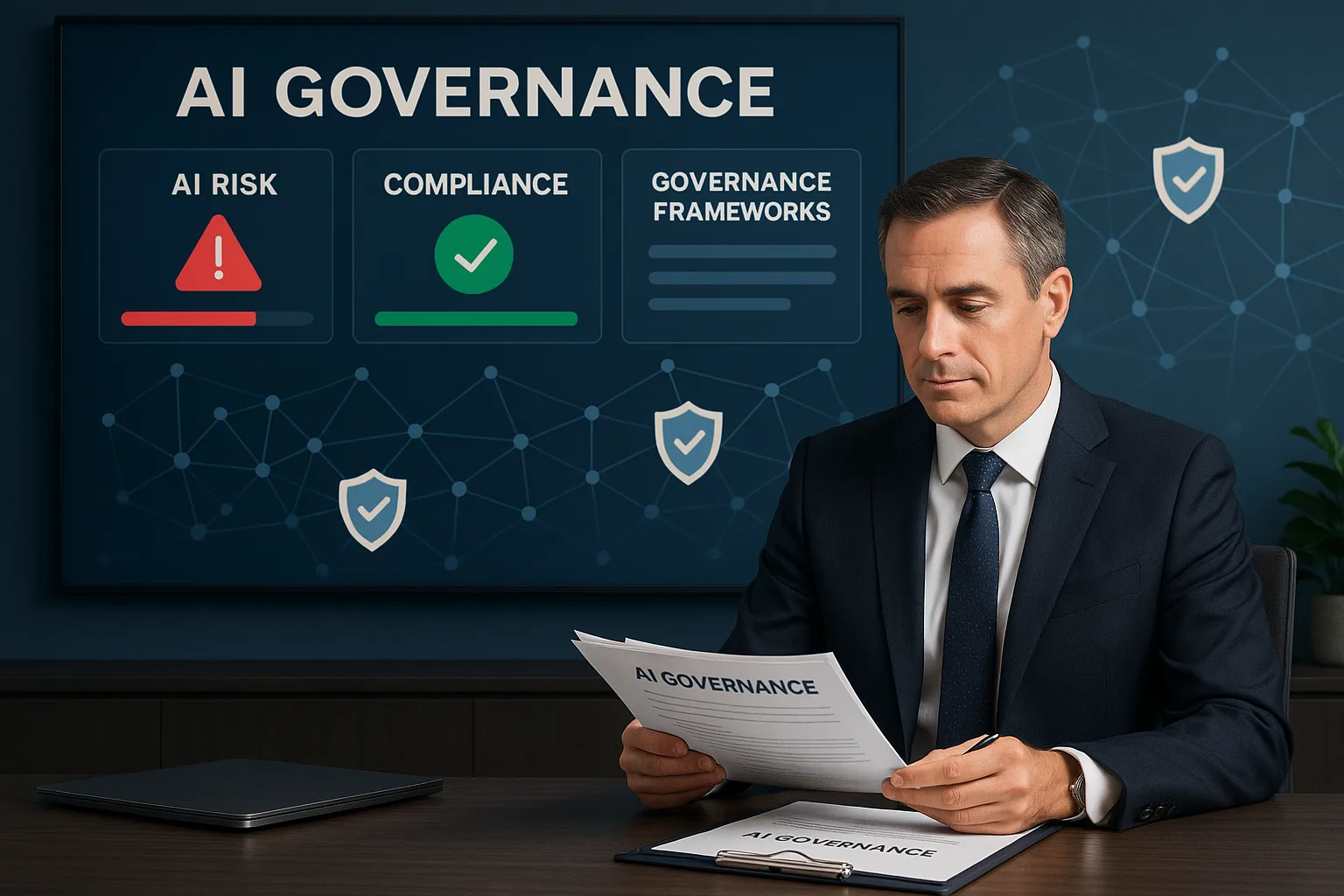
As businesses adopt AI, Chief Risk Officers face the task of managing AI-related risks while enabling innovation. This comprehensive guide provides CROs with practical frameworks for building robust AI governance structures that balance risk mitigation with business growth. From regulatory compliance to ethical considerations, we explore the essential components of effective AI risk management in 2025.
Introduction: The AI Governance Imperative
The rapid adoption of artificial intelligence across enterprise environments has created a new category of risks that traditional governance frameworks struggle to address. As AI systems become more sophisticated and pervasive, Chief Risk Officers must evolve their approach to risk management, incorporating AI-specific considerations into their governance structures.
Recent research indicates that 73% of organisations are actively deploying AI technologies, yet only 34% have established comprehensive AI governance frameworks [1]. This gap represents a significant risk exposure that can lead to regulatory violations, reputational damage, and operational failures. The challenge is particularly acute in the UK, where the government’s pro-innovation approach to AI regulation creates both opportunities and uncertainties for businesses.
The stakes are high. Organisations without proper AI governance face potential fines under emerging regulations, loss of customer trust, and competitive disadvantage. Conversely, those with robust frameworks can accelerate AI adoption while maintaining stakeholder confidence and regulatory compliance.
This guide addresses the critical need for comprehensive AI governance by providing CROs with actionable frameworks, practical implementation strategies, and real-world insights. We examine the current regulatory landscape, explore best practices for AI risk assessment, and outline the essential components of effective governance structures.
Understanding the AI Risk Landscape
The complexity of AI-related risks requires a nuanced understanding of how artificial intelligence differs from traditional technology implementations. Unlike conventional software systems, AI models exhibit behaviours that can be unpredictable, biased, or difficult to explain. These characteristics create unique risk profiles that demand specialised governance approaches.
Algorithmic Bias and Fairness Risks
One of the most significant challenges in AI governance is addressing algorithmic bias. AI systems can perpetuate or amplify existing biases present in training data, leading to discriminatory outcomes that violate regulations and damage organisational reputation. For CROs, this represents both a compliance risk and a strategic business risk.
The impact of algorithmic bias extends beyond legal compliance. Organisations have faced substantial financial penalties and reputational damage due to biased AI systems. For example, financial institutions using AI for credit scoring have encountered regulatory scrutiny when their models demonstrated discriminatory patterns against protected groups.
To address these risks, governance frameworks must include robust bias detection and mitigation strategies. This involves implementing diverse datasets, conducting regular algorithmic audits, and establishing clear accountability mechanisms for AI decision-making processes.
Data Privacy and Security Vulnerabilities
AI systems typically require vast amounts of data to function effectively, creating expanded attack surfaces and privacy risks. The concentration of sensitive information in AI training datasets makes these systems attractive targets for cybercriminals and increases the potential impact of data breaches.
Moreover, AI models themselves can become vectors for data exposure. Techniques such as model inversion attacks can potentially extract sensitive information from trained models, creating novel privacy risks that traditional security frameworks may not address adequately.
CROs must ensure that AI governance frameworks incorporate comprehensive data protection measures, including encryption, access controls, and privacy-preserving techniques such as differential privacy and federated learning.
Model Reliability and Performance Degradation
AI models can experience performance degradation over time due to data drift, concept drift, or changes in the underlying environment. This phenomenon, known as model decay, can lead to increasingly inaccurate predictions and poor business outcomes if not properly monitored and managed.
The challenge is particularly acute in dynamic business environments where the conditions under which AI models operate change frequently. Without proper monitoring and retraining protocols, organisations may unknowingly rely on degraded models, leading to suboptimal decisions and potential losses.
Effective governance frameworks must include continuous monitoring systems that track model performance, detect drift, and trigger retraining or model updates when necessary. This requires establishing clear performance thresholds, monitoring protocols, and escalation procedures.
Regulatory Compliance in the UK Context
The UK’s approach to AI regulation presents both opportunities and challenges for organisations seeking to implement comprehensive governance frameworks. Unlike the European Union’s prescriptive AI Act, the UK has adopted a principles-based approach that emphasises innovation while maintaining appropriate safeguards.
The UK’s Five Core Principles
The UK government has established five core principles for AI regulation that form the foundation of the country’s governance approach [2]:
- Safety, security and robustness
- Appropriate transparency and explainability
- Fairness
- Accountability and governance
- Contestability and redress
These principles create a flexible framework that allows organisations to tailor their governance approaches to their specific circumstances while maintaining appropriate risk controls.
Implications for CROs
The principles-based approach requires CROs to take a more proactive role in defining their organisation’s AI governance standards. Rather than simply complying with prescriptive regulations, they must interpret broad principles and translate them into specific policies and procedures.
This approach offers several advantages. Organisations can develop governance frameworks that align closely with their business objectives and risk tolerance. The flexibility also allows for rapid adaptation as AI technologies and business requirements evolve.
However, the principles-based approach also creates uncertainty. Without detailed regulatory requirements, organisations must make judgement calls about appropriate governance measures, potentially leading to inconsistent approaches across the industry.
To navigate this environment effectively, CROs should engage actively with industry groups, regulatory bodies, and professional associations to stay informed about emerging best practices and regulatory expectations.
Building Comprehensive AI Governance Frameworks
Effective AI governance requires a holistic approach that integrates technical, operational, and strategic considerations. The framework must address the entire AI lifecycle, from initial development through deployment, monitoring, and eventual retirement.
Governance Structure and Accountability
The foundation of effective AI governance is a clear organisational structure that defines roles, responsibilities, and accountability mechanisms. This structure should include both strategic oversight and operational management components.
At the strategic level, organisations should establish an AI Governance Committee comprising senior executives from relevant functions, including risk management, legal, technology, and business units. This committee should be responsible for setting AI strategy, approving major AI initiatives, and overseeing compliance with governance policies.
The committee should be chaired by a senior executive with appropriate authority and expertise, often the Chief Risk Officer or Chief Technology Officer. The chair should have direct reporting relationships to the CEO and board of directors to ensure adequate organisational support and accountability.
At the operational level, organisations should designate AI Risk Managers responsible for day-to-day oversight of AI systems. These individuals should have deep technical expertise in AI technologies and strong understanding of risk management principles. They should report to the AI Governance Committee and have authority to halt AI deployments that pose unacceptable risks.
Risk Assessment and Classification
A critical component of AI governance is the ability to assess and classify AI-related risks systematically. This requires developing standardised risk assessment methodologies that can be applied consistently across different AI applications and business contexts.
The risk assessment process should consider multiple dimensions of AI risk, including technical risks (such as model accuracy and reliability), operational risks (such as system availability and performance), compliance risks (such as regulatory violations and privacy breaches), and strategic risks (such as competitive disadvantage and reputational damage).
Organisations should develop risk classification schemes that categorise AI systems based on their potential impact and likelihood of adverse outcomes. High-risk systems should be subject to more stringent governance requirements, including enhanced monitoring, more frequent audits, and additional approval processes.
The classification scheme should be dynamic, allowing for reclassification as AI systems evolve or as the risk environment changes. Regular reviews should be conducted to ensure that risk classifications remain accurate and appropriate.
Policy Development and Implementation
Comprehensive AI governance requires detailed policies that address all aspects of AI development, deployment, and management. These policies should be specific enough to provide clear guidance while remaining flexible enough to accommodate different AI applications and evolving technologies.
Key policy areas should include:
- AI Development Standards: Policies governing the development of AI models, including data quality requirements, model validation procedures, and documentation standards.
- Deployment Approval Processes: Procedures for reviewing and approving AI system deployments, including risk assessments, stakeholder approvals, and go-live criteria.
- Monitoring and Maintenance Requirements: Standards for ongoing monitoring of AI systems, including performance metrics, alert thresholds, and maintenance schedules.
- Incident Response Procedures: Protocols for responding to AI-related incidents, including escalation procedures, remediation steps, and communication requirements.
- Vendor Management Standards: Requirements for managing third-party AI providers, including due diligence procedures, contract terms, and ongoing oversight requirements.
Policies should be developed through collaborative processes that involve stakeholders from across the organisation. This ensures that policies are practical, comprehensive, and aligned with business objectives.
Implementation Strategies and Best Practices
Successfully implementing AI governance frameworks requires careful planning, adequate resources, and strong organisational commitment. CROs should approach implementation systematically, focusing on building capabilities gradually while maintaining business continuity.
Phased Implementation Approach
Given the complexity of AI governance, organisations should adopt phased implementation approaches that allow for learning and adjustment over time. The implementation should begin with the most critical AI systems and gradually expand to cover all AI applications within the organisation.
Phase 1: Foundation Building should focus on establishing basic governance structures, including the AI Governance Committee, initial policies, and risk assessment procedures. This phase should also include training programmes to build AI literacy among risk management staff and other stakeholders.
Phase 2: System Integration should involve implementing governance procedures for existing AI systems, conducting comprehensive risk assessments, and establishing monitoring capabilities. This phase should also include developing relationships with vendors and other external partners.
Phase 3: Optimisation and Expansion should focus on refining governance processes based on experience, expanding coverage to all AI systems, and implementing advanced capabilities such as automated monitoring and risk assessment tools.
Each phase should include specific milestones, success criteria, and feedback mechanisms to ensure progress and identify areas for improvement.
Technology and Tools
Effective AI governance requires appropriate technology infrastructure to support risk assessment, monitoring, and reporting activities. Organisations should invest in tools that can automate routine governance tasks while providing comprehensive visibility into AI system performance and risk exposure.
Key technology capabilities should include:
- Model Monitoring Platforms: Tools that continuously monitor AI model performance, detect drift, and alert stakeholders to potential issues.
- Risk Assessment Software: Applications that standardise risk assessment processes and provide consistent risk scoring across different AI systems.
- Audit and Compliance Tools: Systems that track compliance with governance policies and generate reports for internal and external stakeholders.
- Documentation and Workflow Management: Platforms that manage AI system documentation, approval workflows, and change management processes.
Organisations should evaluate available tools carefully, considering factors such as integration capabilities, scalability, and vendor stability. In many cases, a combination of commercial tools and custom-developed solutions may be most appropriate.
Measuring Success and Continuous Improvement
AI governance frameworks must include mechanisms for measuring effectiveness and driving continuous improvement. This requires establishing clear metrics, regular assessment processes, and feedback loops that enable ongoing optimisation.
Key Performance Indicators
Organisations should develop comprehensive KPI frameworks that measure both the effectiveness of governance processes and the performance of AI systems under governance. Key metrics should include:
- Risk Metrics: Measures of risk exposure, including the number and severity of AI-related incidents, compliance violations, and near-miss events.
- Process Metrics: Indicators of governance process effectiveness, such as approval cycle times, policy compliance rates, and audit findings.
- Business Impact Metrics: Measures of how governance activities affect business outcomes, including AI project success rates, time-to-market, and return on investment.
- Stakeholder Satisfaction: Feedback from internal and external stakeholders on the effectiveness and efficiency of governance processes.
These metrics should be tracked regularly and reported to senior management and the board of directors. Trends and patterns should be analysed to identify opportunities for improvement and emerging risks.
Regular Assessment and Optimisation
Governance frameworks should be subject to regular assessment and optimisation to ensure they remain effective and relevant. This should include both internal reviews and external assessments by independent parties.
Internal reviews should be conducted quarterly or semi-annually, focusing on process effectiveness, policy compliance, and stakeholder feedback. These reviews should identify specific areas for improvement and develop action plans for addressing identified issues.
External assessments should be conducted annually or bi-annually by qualified third parties with expertise in AI governance and risk management. These assessments should provide independent validation of governance effectiveness and identify best practices from other organisations.
The results of both internal and external assessments should be used to update governance frameworks, policies, and procedures. Changes should be implemented systematically, with appropriate change management processes and stakeholder communication.
Frequently Asked Questions
Q: How do I justify the investment in AI governance to senior management?
A: Focus on the business case for AI governance, emphasising risk mitigation, regulatory compliance, and competitive advantage. Quantify potential costs of governance failures, including regulatory fines, reputational damage, and operational disruptions. Highlight how effective governance can accelerate AI adoption and improve business outcomes.
Q: What are the most common mistakes organisations make when implementing AI governance?
A: Common mistakes include treating AI governance as purely a technical issue, implementing overly complex processes that hinder innovation, failing to engage business stakeholders adequately, and not allocating sufficient resources for ongoing governance activities. Successful implementations balance risk management with business enablement.
Q: How should we handle AI governance for third-party AI services?
A: Develop comprehensive vendor management processes that include due diligence on AI capabilities, contractual requirements for governance standards, ongoing monitoring of vendor performance, and clear escalation procedures for issues. Ensure that vendor AI systems meet the same governance standards as internal systems.
Q: What skills and capabilities do we need to build internally for effective AI governance?
A: Key capabilities include technical understanding of AI technologies, risk assessment and management expertise, regulatory and compliance knowledge, project management skills, and stakeholder communication abilities. Consider a combination of training existing staff, hiring new talent, and engaging external consultants.
Q: How do we balance innovation with risk management in our AI governance approach?
A: Implement risk-based approaches that apply governance requirements proportionate to risk levels. Establish fast-track processes for low-risk AI applications while maintaining rigorous oversight for high-risk systems. Create innovation sandboxes that allow experimentation within controlled environments.
Building robust AI governance frameworks is essential for organisations seeking to use artificial intelligence while managing associated risks effectively. As AI technologies continue to evolve and regulatory requirements become more defined, CROs must take proactive steps to establish comprehensive governance structures that balance innovation with risk management.
The key to success lies in developing frameworks that are comprehensive yet flexible, rigorous yet practical. Organisations that invest in robust AI governance today will be better positioned to capitalise on AI opportunities while avoiding the pitfalls that can derail AI initiatives.
The journey toward effective AI governance is ongoing, requiring continuous learning, adaptation, and improvement. By following the principles and practices outlined in this guide, CROs can build governance frameworks that not only manage risks effectively but also enable their organisations to assess and manage their use of artificial intelligence.
References:
[1] Deloitte AI Institute. (2025). “State of AI Governance Report 2025.” https://www.deloitte.com/global/en/our-thinking/insights/focus/cognitive-technologies/state-of-ai-governance.html
[2] UK Government. (2023). “A pro-innovation approach to AI regulation.” https://www.gov.uk/government/publications/ai-regulation-a-pro-innovation-approach
Get new briefings by email
The AI Consultancy newsletter delivers briefings and analysis for UK businesses. We use your address only to send it, and you can unsubscribe at any time.