The 5 levels of AI literacy: a self-assessment framework for UK teams
What AI literacy means in a business context
AI literacy is a structured measure of how effectively individuals can understand, evaluate, and act on AI tools in a business context. It is not the ability to explain how a transformer model works, and it is not the same as general digital literacy. It is the practical capability to identify where AI applies to your work, select appropriate tools, prompt them effectively, verify their output, and know when not to use AI at all.
The distinction between AI literacy, AI skills, and digital literacy matters for training design. Digital literacy is the broader foundation: email, spreadsheets, shared drives, basic cyber hygiene. AI skills are more technical: building an automation, configuring a retrieval-augmented generation (RAG) pipeline, or fine-tuning a model. AI literacy sits in the middle. It is what every employee using ChatGPT, Claude, Copilot, or Gemini needs, regardless of whether they will ever build an AI system themselves.
The 5-level framework
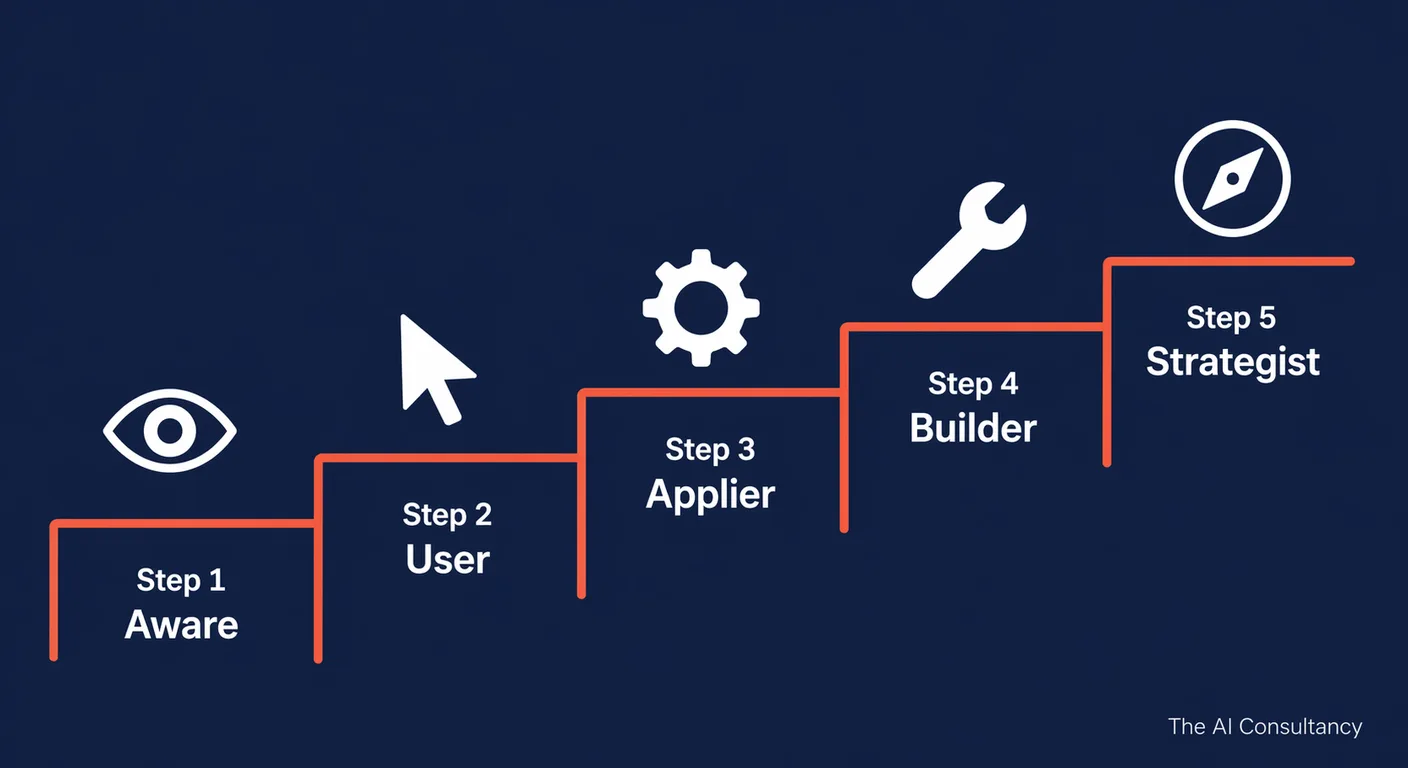
AI literacy progresses through five distinct levels. Each level describes a specific capability set, with clear indicators of what someone at that level can do. The framework is progressive: each level assumes the capabilities of the level below.
| Level | Title | What someone at this level can do | Typical role examples |
|---|---|---|---|
| 1 | AI Aware | Explain what AI is, identify 2 to 3 tools relevant to their work | Most employees at the start of an AI rollout |
| 2 | AI User | Use approved tools effectively for defined tasks; prompt for consistent output | Admin, sales, customer service |
| 3 | AI Applier | Integrate AI into existing workflows; identify process automation opportunities | Operations, project management, finance |
| 4 | AI Builder | Configure automations, build no-code agents, evaluate and connect APIs | Technical operations, IT leads |
| 5 | AI Strategist | Set AI vision, governance, and ROI roadmaps; evaluate vendors; manage risk | C-suite, heads of department |
Level 1, AI Aware. The person understands in plain terms what AI does, can name two or three tools relevant to their job, and recognises when a colleague is using AI effectively. They have no hands-on fluency yet. Most employees in a UK SME at the start of an AI rollout are at this level.
Level 2, AI User. The person uses approved AI tools for specific, defined tasks. They can write a prompt that produces a usable first draft without extensive editing, know the difference between the enterprise and free tiers of the tools they use, and can identify when an output is obviously wrong. Admin, sales, and customer service roles typically need to reach this level as a minimum.
Level 3, AI Applier. The person integrates AI into their existing workflow and identifies opportunities to automate process steps. They can combine tools, for example by pulling data from one system, summarising it with an AI, and writing the summary into another system. Operations leads, project managers, and finance staff in growing UK SMEs should reach this level.
Level 4, AI Builder. The person configures automations end to end, builds no-code agents in tools such as Zapier, Make, or n8n, evaluates API documentation, and connects AI tools into the wider business systems stack. This is a technical operations or IT lead level, not a requirement for most staff.
Level 5, AI Strategist. The person sets the organisation's AI vision, governance policies, and ROI roadmap. They evaluate vendors, manage third-party risk, and decide where AI investment goes. In most UK SMEs, one or two people need to reach this level: typically the Managing Director and either an Operations Director or a Head of IT.
How to assess your team's current level
The most practical way to assess AI literacy is not a quiz. It is a set of capability descriptors that each person can match themselves to, ideally in a short, confidential self-assessment. Managers can run the same exercise independently and compare results. The gap between self-assessment and manager rating is itself a useful signal about where confidence and capability are out of step.
Level 1 indicators. Can you explain in plain terms what a large language model does, without relying on the phrase "it's like magic"? Can you name two or three AI tools your business already uses or licenses? Can you identify when a document has been written primarily by AI? If yes to all three, you are at or above Level 1.
Level 2 indicators. Can you write a prompt that consistently produces the output you need without extensive editing? Do you know whether the AI tool you use is on an enterprise tier with a data processing agreement, or on a free tier that may train on your inputs? Can you spot an obvious factual error in an AI-generated response? If yes to all three, you are at or above Level 2.
Level 3 indicators. Have you mapped at least one of your recurring tasks to an AI-assisted workflow that saves measurable time? Can you explain to a colleague how to set up the same workflow? Do you know where the boundaries are, which tasks in your role are AI-suitable and which are not?
Level 4 indicators. Have you built or configured an automation that connects two or more systems with an AI step in between? Can you read API documentation and identify what authentication, permission, and rate-limit considerations apply? Can you explain what a RAG system is and when it is the right pattern?
Level 5 indicators. Have you made a vendor selection decision for an AI tool, documented with clear criteria? Can you explain the organisation's AI governance position to a regulator, client, or auditor? Do you own the AI roadmap and the AI spend?
Most UK SMEs will find that 70 to 85% of staff sit at Level 1 or Level 2, 10 to 20% at Level 3, and a small number at Level 4 or Level 5. The distribution itself is not a problem. The problem is when the distribution is undocumented, because then training cannot be targeted and compliance evidence cannot be produced.
The EU AI Act literacy obligation: what UK businesses need to know
Article 4, as amended by Regulation (EU) 2026/1744, requires providers and deployers in scope to take measures supporting the development of AI literacy among staff and others using AI on their behalf. Measures must reflect their knowledge, experience, training, the use context and affected people. It does not require a guaranteed individual literacy level or prescribe a fixed course length.
Assess scope under Article 2 by role, EU establishment, placing systems or models on the EU market, and use of system outputs in the Union. Customer nationality or a UK billing address alone is not a reliable scope test.
Our five-level framework is a planning aid, not a legal standard. Set role-specific objectives, document the measures taken and check whether staff can apply them to their actual work. A signed policy and attendance record can support that evidence but do not guarantee compliance.
Building a structured training programme from the framework
The framework maps directly onto training interventions. Once you have assessed your team's current levels, the training plan writes itself.
Level 1 to Level 2. This is the largest volume of training for most UK SMEs. The goal is practical fluency with the organisation's approved tools. Content: tool onboarding (the specific settings, data classification rules, and tier differences), prompt engineering basics, and verification habits. Delivery: two one-hour sessions, supplemented by a shared prompt library. See our guide on prompt engineering for UK business teams for the structured framework most appropriate at this level.
Level 2 to Level 3. Focus shifts from individual tool use to workflow integration. Staff at Level 3 need to see their own work as a sequence of steps, some of which can be AI-assisted. Content: workflow mapping, process audit, tool combinations, and an introduction to data classification in the context of AI inputs. Delivery: a half-day workshop where each participant maps one of their recurring tasks, identifies the AI-suitable steps, and builds a first version.
Level 3 to Level 4. Technical step-up for the small group who will build and maintain AI-assisted workflows. Content: no-code automation platforms such as Make, Zapier, or n8n; API fundamentals; an introduction to RAG and where it fits. Delivery: a structured self-paced programme over four to eight weeks, with a practical project delivered at the end.
Level 4 to Level 5. Governance, vendor selection, and ROI frameworks. This is not training content as much as structured exposure to the commercial and compliance context. Content: EU AI Act scope, UK GDPR and automated decision-making, ISO 42001 as an AI management system standard, and ROI measurement methods. Delivery: external input from legal, compliance, and strategy advisors.
Most UK SMEs should prioritise the Level 1 to Level 2 transition for the majority of staff, and the Level 2 to Level 3 transition for operations leads. Level 4 and Level 5 interventions are typically needed for only one to four people per organisation.
Further reading and services
The 5-level framework is the starting point for any structured AI capability build. For a full readiness review that assesses both your team's literacy and your organisation's technical and governance readiness, see our AI readiness assessment. For a training programme tailored to your team's tools, workflows, and current literacy distribution, see our AI for SMEs service. For more on building AI-ready teams, change management, and governance, see our AI training and capability building section of the Knowledge Hub.
Frequently asked questions
- What is the difference between AI literacy and AI skills?
- AI literacy is the practical capability to use AI tools effectively, verify their output, and know when not to use AI. It applies to every employee working with AI in their role. AI skills are more technical: building automations, configuring RAG systems, or evaluating APIs. Literacy is the foundation; skills build on it for the smaller group who will configure or build AI systems.
- Is AI literacy training required by law for UK businesses?
- Article 4, as amended by Regulation (EU) 2026/1744, requires providers and deployers in scope to take measures supporting the development of AI literacy among staff and others using AI on their behalf. Measures must reflect their knowledge, experience, training, the use context and affected people. It does not require a guaranteed individual literacy level or prescribe a fixed course length. Assess scope under Article 2 by role, EU establishment, placing systems or models on the EU market, and use of system outputs in the Union. Customer nationality or a UK billing address alone is not a reliable scope test.
- How long does it take to move from Level 1 to Level 3?
- For most employees, Level 1 to Level 2 takes two to four weeks of practical use after an initial hour of training, supported by a shared prompt library. Level 2 to Level 3 takes one to three months of deliberate workflow mapping and integration. Cumulatively, a motivated employee in a well-supported environment can reach Level 3 in three to four months. Without structured training, many employees plateau at Level 1 or a shallow Level 2.
- What is the minimum AI literacy requirement for a UK SME deploying ChatGPT?
- We recommend Level 2 as a starting training target for employees who use the tool. They should understand approved accounts, data handling, prompting and verification. The appropriate measures depend on the role and risk; neither this framework nor a one-hour course guarantees Article 4 compliance.
- How does The AI Consultancy assess team AI literacy levels?
- We run a structured assessment combining self-assessment against the 5-level capability descriptors, manager ratings for each team member, and a short practical exercise appropriate to each person's target level. The output is a literacy map showing current and target levels across the organisation, with a training plan that moves each role to its target level. The assessment is part of our AI readiness service.
Get new briefings by email
The AI Consultancy newsletter delivers briefings and analysis for UK businesses. We use your address only to send it, and you can unsubscribe at any time.